
7-Day Morocco Tour from Agadir: Essaouira, Marrakech & the Sahara
From the Atlantic coast at Essaouira to the Red City of Marrakech and on into the Sahara — a full week that ties together the coast, the Atlas and the dunes of Merzouga, in a private loop back to Agadir.
Reviewed by Aziz Karaoui, Co-Founder & Morocco Travel Expert at Desert Morocco Tour · Updated September 13, 2026
Coast, City and Desert, in One Loop from Agadir
Rather than heading straight inland for the Sahara, this 7-day route takes the scenic way round: north along the Atlantic to the fortified port town of Essaouira, on to Marrakech for a full guided day in the medina, and only then south over the High Atlas toward the desert. It's a fuller picture of Morocco than a direct desert dash — coastline, imperial city and dunes all in a single loop that returns to where it started.
The desert stage itself follows a familiar shape once it begins: Ait Ben Haddou and Ouarzazate, the Dades and Todra valleys, and a night at a camp in the Erg Chebbi dunes near Merzouga, before a long but scenic return through the Draa Valley, Taznakht and the saffron region around Taliouine. A private, air-conditioned vehicle and an English-speaking driver run through the whole week, with a local guide joining specifically for the Marrakech walking tour.
Why This Route Goes North Before Turning to the Sahara
A direct Agadir-to-Merzouga drive is shorter, but it skips the Atlantic coast and Marrakech entirely. This itinerary uses the extra days deliberately: Essaouira and Marrakech first, so the desert stage isn't the only thing the trip is built around. The return leg then avoids retracing the outbound route — instead of driving back through Marrakech, it loops south through the Draa Valley and the saffron town of Taliouine, so almost the entire week covers new ground.
Jump to a day
Request Your Personalized Quote
Share your travel dates, number of travelers, preferred accommodation level and any special interests. We'll prepare a personalized quotation for your private 7-day Morocco journey from Agadir through Essaouira, Marrakech and the Sahara.
How Does the 7-Day Itinerary Unfold?
Every night's accommodation is confirmed in advance — this is a guide to how the days unfold, not a loose outline.
Agadir — Essaouira
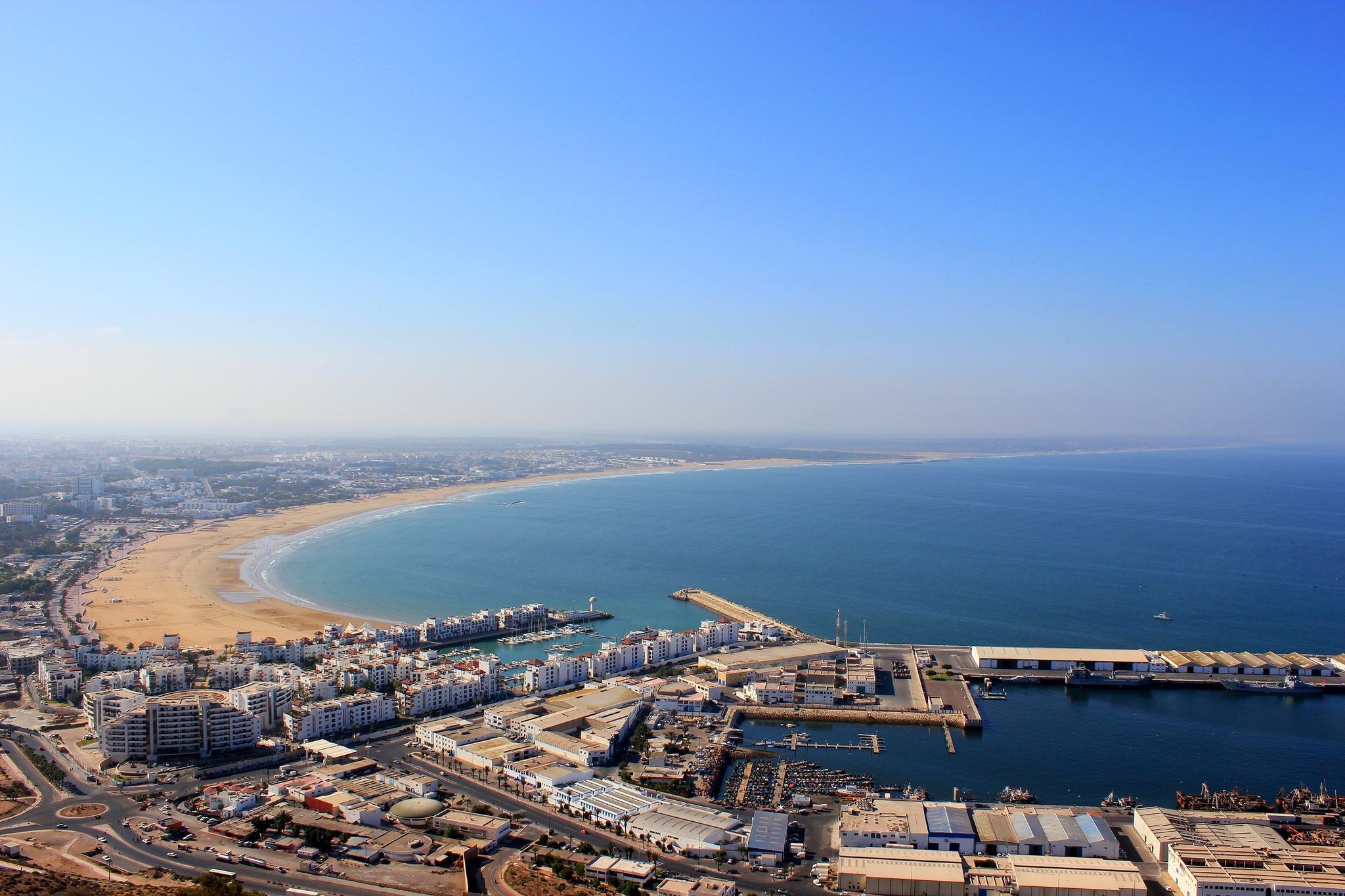
Your driver collects you from your hotel or the airport in Agadir, with time first for a couple of the city's own landmarks — the Kasbah, rebuilt on its hilltop above the bay, offers a wide panoramic view over Agadir and the coastline, and a stop at Crocoparc, Morocco's zoological park, is an easy add-on for families or anyone curious about it.
The drive north to Essaouira follows the coast for around three hours, with stops along the way at viewpoints and small fishing communities. By the time you arrive, there's time to settle into a riad inside Essaouira's old medina before the evening.
- Agadir Kasbah viewpoint and optional Crocoparc visit
- Scenic coastal drive to Essaouira
- Overnight: riad, Essaouira medina
Essaouira — Marrakech
The morning is free to explore Essaouira properly. Rebuilt in the 18th century under Sultan Mohammed III, its medina is one of the more relaxed in Morocco — the Portuguese-built ramparts along the seafront, the working fishing port where the day's catch is sold and haggled over each morning, and simply time on the beach are all worth the unhurried pace.
After lunch, the route turns inland toward Marrakech, with a stop at an argan oil cooperative along the way to see the traditional hand-pressing process behind one of the region's best-known exports. The evening is spent settling into a riad in the Marrakech medina.
- Free morning in Essaouira: ramparts, port and medina
- Argan oil cooperative stop en route
- Overnight: riad, Marrakech (night 1 of 2)
Guided Day in Marrakech
A local guide meets you mid-morning for a walking tour through the heart of the medina — the Koutoubia Mosque, the Saadian Tombs, the Bahia Palace, and the Ben Youssef Madrasa are woven together with time in the souks around Jemaa el-Fna square, where the day's market stalls and street performers give a sense of the city's constant motion.
After lunch, the pace shifts entirely for the Majorelle Garden in Gueliz, Marrakech's modern quarter — a cobalt-blue villa and botanical garden that couldn't feel further from the medina's density. The rest of the evening is free to relax or explore further at your own pace.
- Guided walk: Koutoubia Mosque, Saadian Tombs, Bahia Palace, Ben Youssef Madrasa
- Souks around Jemaa el-Fna square
- Majorelle Garden in Gueliz
- Overnight: riad, Marrakech (night 2 of 2)
Marrakech — High Atlas — Ait Ben Haddou — Rose Valley — Dades Valley
The road climbs out of Marrakech over the High Atlas via the Tizi n'Tichka pass, with Berber villages dotting the mountainside and plenty of stops for photos along the way. On the far side, the ksar of Ait Ben Haddou — a UNESCO World Heritage site and one of the most recognisable fortified villages in Morocco — is worth an unhurried visit before continuing to Ouarzazate, known locally as the Hollywood of Morocco for its film studios.
After lunch, the "route of a thousand kasbahs" leads to the Valley of Roses around Kalaat M'Gouna, before a final forty-minute stretch brings you to the Dades Valley for the night, ahead of the desert crossing tomorrow.
Ait Ben Haddou is called "a striking example of the architecture of southern Morocco" by UNESCO World Heritage
- Crossing of the High Atlas via the Tizi n'Tichka pass
- Ksar of Ait Ben Haddou and Ouarzazate
- Valley of Roses at Kalaat M'Gouna
- Overnight: hotel, Dades Valley
Dades Valley — Todra Gorges — Erfoud — Merzouga Desert
The morning follows the Dades Valley toward the Todra Gorges, where a fifteen-minute walk along the canyon floor brings you beneath towering red cliffs with a stream running alongside — one of the more striking short stops on the whole route. Lunch follows in Tinjdad or Touroug, before continuing to Erfoud, known across Morocco for its dates and fossil workshops.
Erfoud is the last stop before the dunes. In Merzouga, camels are waiting for the ride into the Erg Chebbi dunes, arriving at a desert camp in time to settle in before dinner, music around the fire, and a night under a genuinely dark sky.
- Todra Gorges on foot
- Erfoud's fossil workshops
- Camel ride into the Erg Chebbi dunes
- Overnight: desert camp, Merzouga
Merzouga — Rissani — Draa Valley — Ouarzazate
An early rise rewards you with sunrise over the dunes, best watched from wherever you happen to be standing near camp. After breakfast and a shower, the camels (or a 4x4, if you'd prefer) carry you back to the village to begin the day's drive.
Rissani is the first stop — its souk is considered the largest in southern Morocco, and worth the half hour it takes to wander. From there the route continues through Alnif and Tazarine into the Draa Valley, where an almost unbroken run of palm groves lines the road through Agdz, before the day ends in Ouarzazate at a riad or hotel.
- Optional sunrise over the dunes
- Rissani's souk
- Draa Valley palm groves via Alnif, Tazarine and Agdz
- Overnight: riad or hotel, Ouarzazate
Ouarzazate — Taznakht — Taliouine — Taroudant — Agadir
The final day crosses back through Taznakht, well known for its Berber rugs and kilims, before a run of mountain roads brings you to Taliouine — one of the few places in Morocco where saffron is commercially grown. Lunch here is a fitting last stop before the road continues through Taroudant and on to Agadir, roughly three hours further, bringing the week to a close with a drop-off at your hotel or the airport.
- Berber rugs and kilims in Taznakht
- Lunch in the saffron town of Taliouine
- Return via Taroudant to Agadir, end of services
Todra Gorges vs. Dades Valley
The Dades Valley is broad and open, with kasbah architecture and dramatic rock formations visible from a scenic road. The Todra Gorges are the opposite — a narrow canyon you walk into on foot, with sheer red cliffs rising on either side and a stream running through it. This route includes both, on consecutive days, so the contrast is part of the experience rather than a choice you have to make.
What Makes This 7-Day Journey Premium?
The accommodation here is riads and hotels, with one night at a desert camp — comfortable, well-located, not uniformly five-star. What's genuinely premium is structural: a private vehicle and driver for the full week, a local guide specifically where it adds value (Marrakech), and a route built to avoid backtracking.
A camel-free 4x4 alternative to the desert camp is available if you'd rather not ride, and the route itself can be adjusted before booking.
- Privacy — your own vehicle and driver, not a shared coach
- Service — the same driver with you throughout
- Local guiding — a walking guide for the Marrakech day
- Choice — camel or 4x4 to the desert camp
- Personalization — pace and stops adjusted to you
- Logistics — door-to-door Agadir loop, luggage handled throughout
Private vs. Group Agadir Desert Tour
Both formats have their place — this is a private tour, but here's an honest comparison.
| This Private Tour | Typical Group Tour | |
|---|---|---|
| Vehicle | Your party only | Shared with other travelers |
| Departure time | Set around your preference | Fixed group schedule |
| Photo stops | Adjustable as you go | Fixed to the group's pace |
| Desert transfer | Camel or 4x4, your choice | Usually fixed for the whole group |
| Cost | Generally higher per person | Generally lower, shared costs |
How Much Does a 7-Day Morocco Tour from Agadir Cost?
There's no single fixed price published for this route, because cost depends on group size, travel dates, accommodation category and vehicle. Request a quote with your dates and group size, and you'll receive a full breakdown to compare against other operators.
What's Included & What's Not
Included
- Private transport with an English-speaking driver
- Pickup and drop-off in Agadir
- 6 nights' accommodation with breakfast
- Luggage handling throughout
- Camel trek (one per person)
- Desert tent at the Merzouga camp
- Water and tea in the desert
- 4x4 transfer to/from the camp available as a camel-free alternative
- Sandboarding at the desert camp
- Entrance fees for the sites specifically listed in this itinerary
- Local guide for the Marrakech walking tour
- Fuel for the entire tour
Not Included
- International flights
- Beverages
- Lunches
- Travel insurance
- Tips and gratuities
- Entrance fees not specifically listed above
Where Do This Page's Facts Come From?
- UNESCO — Ksar of Ait-Ben-Haddou — official World Heritage listing.
Frequently Asked Questions
What can I see in Morocco in 7 days from Agadir?
On this loop: Agadir, the Atlantic coast at Essaouira, a full guided day in Marrakech, the High Atlas, Ait Ben Haddou, the Dades and Todra valleys, one night in the Sahara at Merzouga, the Draa Valley, and the saffron town of Taliouine on the way back.
Can you visit the Sahara from Agadir?
Yes. This 7-day loop reaches the Erg Chebbi dunes near Merzouga, with one night at a desert camp, before returning to Agadir by a different route through the Draa Valley.
Why does this Agadir tour go north to Essaouira and Marrakech first?
Rather than driving straight for the Sahara, this route uses the extra days to properly include the Atlantic coast and Marrakech's medina before turning toward the desert — a fuller picture of Morocco than a direct there-and-back desert dash.
Is this a private tour?
Yes, you travel in a private vehicle with an English-speaking driver throughout, rather than joining a fixed group.
Does the tour return to Agadir?
Yes, it's a loop — starting and finishing in Agadir, with the return route passing through different towns (the Draa Valley, Taznakht, Taliouine, Taroudant) than the outbound leg.
Is Marrakech guided on this tour?
Yes, a local guide joins you for a full walking tour of the Marrakech medina on Day 3, covering the Koutoubia Mosque, the Saadian Tombs, the Bahia Palace and the souks around Jemaa el-Fna.
How many nights are spent in the desert?
One night at a desert camp in the Erg Chebbi dunes near Merzouga, reached by camel, with sandboarding available at the camp and the option of a 4x4 transfer instead of riding.
Is camel riding mandatory?
No. A 4x4 transfer to and from the desert camp is available as an alternative to the camel ride if you'd prefer not to ride.
What is the difference between Dades and Todra?
The Dades Valley is broader, with kasbah architecture and rock formations along a scenic road, while the Todra Gorges are a narrow canyon you walk into on foot, with sheer red cliffs on either side. This route includes both.
Is Ait Ben Haddou worth visiting?
Yes — it's a UNESCO World Heritage fortified ksar and one of the most recognizable historic sites in Morocco, historically a stop on the caravan route between the Sahara and Marrakech.
Are entrance fees included?
Entrance fees are included for the sites specifically listed as included in this itinerary. Not every possible stop or optional site is covered.
What accommodation is included?
Riads and hotels throughout the route, plus one night at a desert camp near Merzouga. Exact properties depend on availability and your preferred category.
How much does a 7-day Morocco tour from Agadir cost?
Pricing depends on your travel dates, group size and choice of accommodation category, so we provide a personalized quotation rather than a fixed listed price.
What is the best time of year for this route?
October to April offers the most comfortable temperatures across the coast, the mountains and the desert stages alike. Summer brings pleasant weather to Essaouira but considerable heat once the route reaches Ouarzazate and Merzouga.
How much driving is involved?
Most days combine several hours of driving with sightseeing stops. Day 4 (Marrakech to Dades via the High Atlas and Ait Ben Haddou) and the final return day are the longest.
Can the itinerary be customized?
Yes. Accommodation category, pace, and specific stops can all be adjusted before your trip is confirmed.
Related Itineraries
We're a Message Away.
Send your dates and questions and we'll help you shape this route to fit your trip.