
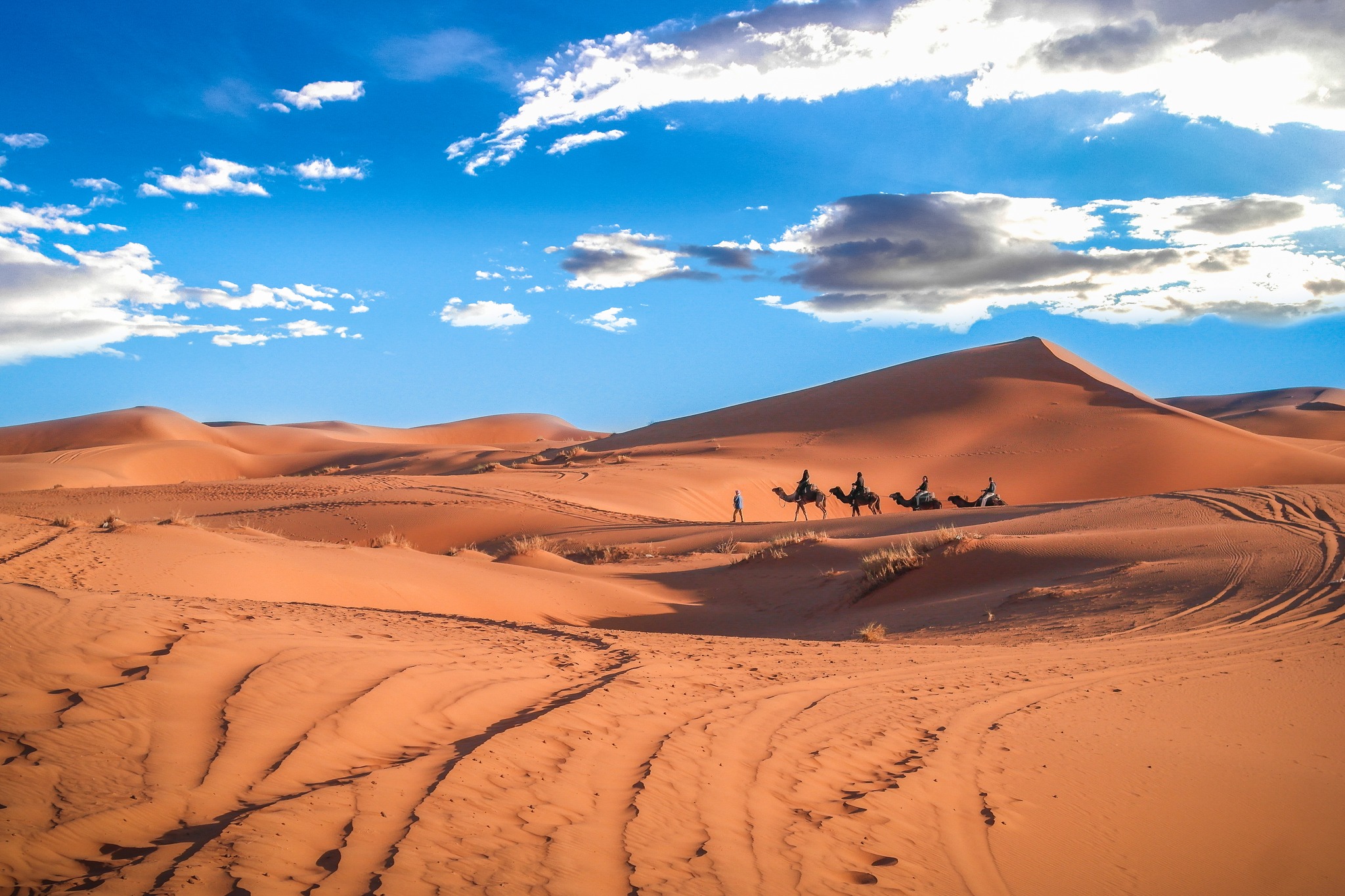
9-Day Morocco Photography Tour: Marrakech, Sahara & Fes
From the kasbahs of the south to the Sahara dunes and the Atlantic coast — a private route across Morocco built around light, colour and the moments in between.
Reviewed by Aziz Karaoui, Co-Founder & Morocco Travel Expert at Desert Morocco Tour · Updated September 13, 2026
Is This a Photography Tour or a Workshop?
This 9-day route is built for travellers who want to capture the full range of Morocco through a lens — the buzz of Marrakech's medina, the ancient ksar of Ait Ben Haddou, the High Atlas Mountains, palm oases, the Sahara at Erg Chebbi, and the imperial architecture of Fes, Rabat and Casablanca. It's a private photography-focused tour, not a technical workshop: there's no professional photographer running formal instruction on composition or editing. What it offers instead is a route, pace and schedule genuinely built around good light and photogenic locations, with general guidance available for anyone who wants it.
Private transport, an English-speaking driver-guide and handpicked accommodation run throughout, for a portfolio that spans the whole country — street, architecture, landscape, desert and night sky.
Six Photographic Pillars in One Route
Street
Marrakech's souks, Fes's medina, markets and daily life.
Architecture
Ait Ben Haddou, kasbahs, Fes, Rabat, the Hassan II Mosque.
Landscape
High Atlas, the Dades and Todra valleys, the Ziz Valley.
Desert
Erg Chebbi's dunes, sunset, sunrise and night sky.
People & Culture
Artisans, markets, a respectful nomad family visit.
Atlantic & Urban
Rabat, Casablanca, the Atlantic coast, modern architecture.
Jump to a day
Request Your Private Photography Tour Quote
Share your travel dates, group size and preferred accommodation level, and you'll receive a tailored quote for this 9-day photography journey.
How Does the Light and Route Unfold Each Day?
Every night's accommodation is confirmed in advance — this is a guide to how the light and locations unfold, not a loose outline.
Arrival in Marrakech — Medina Photo Walk
The journey begins in Marrakech. After checking into your riad, a relaxed photo walk through the old medina captures the warm colour of the souks, artisans at work in narrow alleys, and everyday street life. As sunset nears, a rooftop terrace overlooking Jemaa el-Fna gives golden-hour views of the square's performers and lantern stalls.
- Photo walk through the Marrakech medina and souks
- Golden hour over Jemaa el-Fna from a rooftop terrace
- Overnight: riad, Marrakech
Marrakech — High Atlas — Ait Ben Haddou
The road climbs across the High Atlas via the Tizi n'Tichka pass, past terraced fields, hillside Berber villages and wide panoramic viewpoints. By afternoon, the ksar of Ait Ben Haddou comes into view — its clay walls glow in the late light, and the narrow alleys offer plenty of architectural detail before a climb to the top for sunset over the valley.
- Crossing of the High Atlas via the Tizi n'Tichka pass
- Late-afternoon and sunset photography at Ait Ben Haddou
- Overnight: guesthouse, near Ait Ben Haddou
Ait Ben Haddou — Ouarzazate — Skoura — Dades Valley
A stop in Ouarzazate, sometimes nicknamed Morocco's "Hollywood" for its film studios, brings a chance to photograph the Taourirt Kasbah, before continuing to the Skoura oasis — palm groves and the mud-brick Amridil Kasbah, one of the most photogenic corners of the south. The afternoon runs through the Rose Valley and into the Dades Gorge, ending with sunset over the valley's winding road.
- Taourirt Kasbah in Ouarzazate
- Skoura oasis and the Amridil Kasbah
- Sunset over the Dades Gorge
- Overnight: hotel, Dades Valley
Dades Valley — Todra Gorge — Erfoud — Merzouga
A morning walk into the Todra Gorge brings towering limestone cliffs and strong, graphic compositions, followed by a stop in Erfoud, known for fossil workshops and good detail shots. By late afternoon, Merzouga and the Erg Chebbi dunes come into view: a camel trek into the sand — a 4x4 transfer can be arranged instead if you'd prefer not to ride — and a climb up a high dune for sunset, before a night at a luxury desert camp.
- Todra Gorge on foot
- Fossil workshops in Erfoud
- Camel trek (or 4x4 alternative) and sunset over Erg Chebbi
- Overnight: luxury desert camp, Erg Chebbi
Erg Chebbi — Sunrise Shoot — Nomad Visit — Desert Exploration
An early sunrise session over the dunes captures the soft light and clean lines of the sand at their best. After breakfast, a visit to a nearby nomad family offers a chance for respectful portraits and daily-life moments — always ask before photographing, and expect the visit to be treated as a genuine encounter rather than a staged photo stop. A 4x4 route through panoramic spots and mineral fields around Merzouga follows, and a second golden-hour shoot in the dunes closes the day. Clear, dark skies here make for a strong (though weather- and moon-phase-dependent) astrophotography opportunity.
- Sunrise session over the Erg Chebbi dunes
- Respectful nomad family visit
- 4x4 exploration and a second golden-hour shoot
- Overnight: hotel, Merzouga
Merzouga — Ziz Valley — Middle Atlas — Fes
One of the longer driving days on the route. It heads north through the Ziz Valley, with its palm groves, old irrigation channels and river canyons offering a striking change in landscape. A lunch stop in Midelt precedes a drive through the Middle Atlas cedar forest, where Barbary macaques sometimes appear along the road. Arrival in Fes by late afternoon leaves a relaxed evening walk for blue-hour shots of the city's mosques and medieval walls.
- Ziz Valley palm groves and canyons
- Middle Atlas cedar forest
- Blue-hour walk in Fes
- Overnight: riad, Fes
Fes — Guided Photography Tour of the Medina
A full day in Fes, one of Morocco's richest cities for photography. A local guide leads the way through the maze-like medina — tanneries, artisan workshops, markets and historic buildings — with elevated viewpoints over the rooftops and minarets. It's a day built for portrait, architecture and street photography in equal measure.
- Guided photography tour of the Fes medina
- Tanneries, artisan workshops and markets
- Elevated rooftop and skyline viewpoints
- Overnight: riad, Fes
Fes — Rabat — Casablanca
The route turns toward the Atlantic coast with a stop in Rabat — the Hassan Tower, the Kasbah of the Udayas and the Andalusian Gardens offer clean architectural lines and blue-and-white alleys over the ocean. Continuing to Casablanca, the afternoon is spent at the Hassan II Mosque's exterior and oceanfront setting, suited to wide-angle and golden-hour shots, before an evening walk along the Corniche for the city's coastal skyline.
- Rabat: Hassan Tower, Kasbah of the Udayas, Andalusian Gardens
- Hassan II Mosque exterior, Casablanca
- Evening walk along the Corniche
- Overnight: hotel, Casablanca
Casablanca — Marrakech (Departure)
A relaxed final morning in Casablanca leaves time for any last images of the city's modern architecture or seaside views before the drive back to Marrakech. On arrival, transfer to the airport or your accommodation, depending on your flight.
- Free morning in Casablanca
- Scenic drive back to Marrakech
- Trip ends: Marrakech
Why Private Travel Matters for Photographers
On a shared coach tour, the vehicle leaves on schedule whether or not the light is right. Here, your driver-guide can wait a few extra minutes for a cloud to move, or start earlier if sunrise is what you're after.
For photographers, that translates directly into better images: a private vehicle able to stop for a composition, room for equipment, and a schedule genuinely built around sunrise and sunset rather than around them.
- Private vehicle and driver-guide throughout
- Schedule built around sunrise, sunset and blue hour
- Stops for composition, without holding up a group
- Diverse subjects: street, architecture, landscape, desert, night sky
- Local guide specifically for the Fes photography day
What Photography Gear Should You Bring?
Equipment Basics
A versatile zoom covers most days; a wide-angle lens suits the Sahara, Ait Ben Haddou and architecture; a telephoto is optional for detail and portrait work. Spare batteries, memory cards, a lens cloth, and a padded bag round out the essentials. A tripod helps for sunrise, blue hour and astrophotography, but isn't required — smartphones and basic cameras work well too if your goal is simply better travel photography.
Protecting Gear in the Sahara
Avoid changing lenses in windy conditions, keep equipment in a sealed bag or case when not shooting, and wipe everything down at the end of each desert session. Confirm charging facilities at your desert camp when requesting your quote, since this varies by camp and category.
When Is the Best Time for Morocco Photography?
Spring (March-May) and autumn (September-November) offer comfortable temperatures and generally clearer light across the mountains, desert and coast. Summer heat can create midday haze in the Sahara, though early and late light still works well. Winter brings colder desert nights but often very clear skies, which can favor astrophotography — conditions on any given night still depend on the moon phase and weather, so nothing can be guaranteed.
How Much Driving Is Involved?
Day 6 (Merzouga to Fes via the Ziz Valley and Middle Atlas) and Day 8 (Fes to Rabat to Casablanca) are the longest driving days on the route, each combining several hours on the road with photography stops built in along the way. Most other days are shorter transfers paired with a specific photographic destination.
Accommodation Night by Night
Riads in Marrakech and Fes, a guesthouse near Ait Ben Haddou, hotels in the Dades Valley and Casablanca, one night at a luxury desert camp in Erg Chebbi, and a second night at a hotel in Merzouga. If you'd prefer both desert nights at the camp rather than a hotel on the second, this can be requested when you submit your quote.
What's Included & What's Not
Included
- Private, air-conditioned 4WD or minivan
- Professional English-speaking driver-guide
- Daily hotel pickup and drop-off, with luggage service
- 8 nights' accommodation: riads, a guesthouse, hotels and one luxury desert camp night
- Entrance fees to the sites and monuments specifically listed in this itinerary
- Local guide for the Fes photography day
- Off-road 4x4 exploration around the Merzouga dunes
- Camel trek in the Sahara Desert (4x4 alternative available)
- Sandboarding in the dunes
Not Included
- International flights
- Travel insurance
- Lunches
- Tipping
- Personal expenses
How Much Does This Photography Tour Cost?
There's no single fixed price published for this route, because cost depends on group size, travel dates and accommodation category. Request a quote with your dates and group size, and you'll receive a full breakdown to compare against other operators.
Frequently Asked Questions
Is this a photography tour or a photography workshop?
It's a private photography-focused tour rather than a technical workshop. There's no professional photographer or formal instruction in composition or editing — instead, the route, pacing and timing are built around good light and photogenic locations, with general guidance available for anyone who wants it.
Does this tour suit beginner photographers?
Yes. The route and pacing are built around strong light and locations, with guidance available for anyone who wants it, so both beginners and experienced photographers get value from the same itinerary.
Is the tour suitable for experienced photographers?
Yes — the value for experienced photographers is less about instruction and more about access, timing and pace: sunrise and sunset sessions built into the schedule, a private vehicle that can stop for a composition, and a genuinely diverse set of subjects from street to landscape to night sky.
How is this different from the 7-day Sahara & Nomad Life tour?
This 9-day route covers more ground: it continues north from Merzouga through Fes, Rabat and Casablanca, adding imperial-city architecture and Atlantic coastline to the desert and kasbah stages both tours share.
How many nights are spent in the desert?
One night at a luxury desert camp in the Erg Chebbi dunes near Merzouga, with a sunset camel trek on arrival and a sunrise session the following morning, plus a second night at a hotel in Merzouga for a full day of desert exploration in between.
Can we spend a second night at the desert camp instead of a hotel?
Yes, this can be requested when you submit your quote — it's a straightforward adjustment to the standard itinerary.
Is this a private tour?
Yes, private throughout, with your own driver-guide and vehicle, so stops for light and composition can be made whenever they're needed.
Is camel riding mandatory?
The camel trek into Erg Chebbi is part of the standard itinerary, but a 4x4 transfer can be arranged instead if you'd prefer not to ride — mention this when requesting your quote.
Can we photograph the Milky Way in the Sahara?
The desert's dark skies make it a strong location for astrophotography, but visibility depends on the moon phase, season and weather on your specific dates, so this can't be guaranteed.
Can I photograph people in Morocco?
Yes, but always ask first and respect a refusal — this applies especially to the nomad family visit near Merzouga, which is approached as a respectful visit rather than a staged photo opportunity.
What camera equipment should I bring?
A versatile zoom covers most days, a wide-angle lens suits the Sahara and architecture, spare batteries and memory cards are essential, and a lens cloth and dust protection matter most in Erg Chebbi. A tripod helps for sunrise, blue hour and astrophotography, but isn't required.
How do I protect my camera from Sahara sand?
Avoid changing lenses in windy conditions, keep gear in a sealed bag or case when not shooting, and wipe down equipment at the end of each desert session before it goes back in your bag.
Does the desert camp have electricity for charging batteries?
This depends on the specific camp and category selected — confirm charging facilities when you request your quote so you can plan spare batteries accordingly.
What accommodation is included?
Riads in Marrakech and Fes, a guesthouse near Ait Ben Haddou, hotels in the Dades Valley and Casablanca, one night at a luxury desert camp in Erg Chebbi, and a second night at a hotel in Merzouga.
Are entrance fees included?
Entrance fees to the sites and monuments specifically listed in this itinerary are included.
How much driving is involved?
Day 6 (Merzouga to Fes via the Ziz Valley and Middle Atlas) and Day 8 (Fes to Rabat to Casablanca) are the longest driving days. Most other days combine several hours on the road with photography stops built in.
What is the best time of year for Morocco photography?
Spring (March-May) and autumn (September-November) offer comfortable temperatures and clearer light across the mountains, desert and coast. Summer heat can create midday haze in the Sahara; winter brings colder desert nights but often very clear skies.
How much does a private Morocco photography tour cost?
Cost depends on group size, travel dates and accommodation category, so we provide a personalized quotation rather than a fixed listed price.
Can the itinerary be customized?
Yes. Accommodation category, pace, an added second desert camp night, or extra time in any location can all be adjusted before your trip is confirmed.
How do I get a price for this tour?
Pricing depends on your travel dates, group size and choice of accommodation category, so share your details through the form on this page or over WhatsApp and you'll receive a tailored quote.
Related Photography Experiences
Start Planning Your Private Morocco Photography Tour.
Whether it's a solo trip, a couple travelling together, or a small private group, send your dates and questions and we'll make sure it's built around your light and your pace.