
7-Day Morocco Tour from Fes: Imperial Cities, Chefchaouen & Sahara
A complete private loop through Morocco in one week — all four imperial cities, Roman ruins at Volubilis, the blue-washed lanes of Chefchaouen, a guided day in Marrakech, and a night under canvas in the Merzouga dunes, all the way back to Fes.
Reviewed by Aziz Karaoui, Co-Founder & Morocco Travel Expert at Desert Morocco Tour · Updated September 13, 2026
Morocco in a Week, Coast to Desert
This seven-day circuit is built for travelers who want the full picture of Morocco without splitting the trip into separate visits. It links all four of Morocco's imperial cities — Fes, Meknes, Rabat and Marrakech — with the Roman ruins of Volubilis, the blue lanes of Chefchaouen in the Rif Mountains, and a night in the Sahara at Merzouga, moving in a wide loop that starts and ends in Fes.
Each day covers real ground, but the pace stays manageable: two travel days at the start move through northern Morocco and the coast, a full day is set aside in Marrakech with a local guide, and the return leg to Fes is spread across two days that pass through the High Atlas, the Dades Valley, Todra Gorges and the dunes of Merzouga before looping back north through the Middle Atlas. A private, air-conditioned vehicle and driver run throughout the full week.
Why This Route Covers All Four Imperial Cities
Fes
Your start and end point — Morocco's historic spiritual and cultural capital.
Meknes
Built under Sultan Moulay Ismail, with the monumental Bab Mansour gate.
Rabat
The historic imperial city that is also Morocco's modern political capital.
Marrakech
The southern imperial capital, with a full guided day on this route.
Few 7-day Morocco itineraries genuinely combine all four — most Fes-based routes stop at two or three. This loop adds Chefchaouen and Casablanca on top, without skipping any of the imperial cities to fit them in.
Jump to a day
Request Your Tailor-Made 7-Day Tour
Tell us your travel dates, number of travelers, preferred accommodation level and any places you'd like to spend more time. We'll prepare a personalized quotation for your private 7-day Morocco journey.
How Does the 7-Day Itinerary Unfold?
Every night's accommodation is confirmed in advance — this is a guide to how the days unfold, not a loose outline.
Fes to Chefchaouen via Meknes and Volubilis
The trip begins with a morning pickup from your riad or the airport in Fes. The first stop is Meknes, one of Morocco's four imperial cities, where a walking visit takes in the monumental Bab Mansour gate, the Sahrij Souani reservoir, the old royal stables and granary, and the mausoleum of Sultan Moulay Ismail. There's free time to grab lunch in the city before moving on.
A short drive outside Meknes brings the group to Volubilis, a UNESCO-listed Roman archaeological site with some of the best-preserved mosaic floors in North Africa, along with standing columns and triumphal arches dating back nearly two thousand years.
From Volubilis, the route heads north through Ouazzane and into the Rif Mountains, arriving by late afternoon in Chefchaouen — the Blue City — known for its indigo-washed medina walls and stairways. The night is spent in a hotel in town.
Volubilis is inscribed as "an exceptionally well preserved example of a large Roman colonial town" — UNESCO World Heritage
- Bab Mansour gate and the Sahrij Souani reservoir, Meknes
- Roman ruins of Volubilis
- Overnight: hotel, Chefchaouen
Chefchaouen to Rabat over the Rif Mountains
The morning is free to wander Chefchaouen's blue medina at leisure before departure. The drive south crosses back over the Rif Mountains toward Rabat, Morocco's political capital and another of the country's imperial cities, set on the Atlantic coast in the northwest.
In Rabat, the afternoon covers the city's landmark sites: the unfinished Hassan Tower and its forest of sandstone columns, the mausoleum of King Mohammed V, and the Kasbah of the Oudayas, a fortified quarter of whitewashed and blue-painted houses overlooking the river mouth. The night is spent in a riad in the capital.
- Free morning in Chefchaouen
- Hassan Tower, Mausoleum of Mohammed V, Kasbah of the Oudayas
- Overnight: riad, Rabat
Rabat to Marrakech via Casablanca
Leaving Rabat, the route follows the Atlantic coastline south to Casablanca, Morocco's largest city and its economic center. The main stop is the Hassan II Mosque, among the largest mosques in the world and built partly over the ocean. From there, a short tour takes in the Corniche waterfront, Mohammed V Square, and a stop at the café made famous by the film Casablanca.
By afternoon, the drive turns inland toward Marrakech, the Red City and one of Morocco's four imperial capitals. On arrival there's time to wander Jemaa el-Fna square as it comes to life in the evening, with its food stalls, storytellers and street performers. Overnight stay in a riad.
- Hassan II Mosque and the Casablanca Corniche
- Evening arrival at Jemaa el-Fna, Marrakech
- Overnight: riad, Marrakech (night 1 of 2)
Guided Sightseeing Day in Marrakech
A full day is set aside to explore Marrakech with a local guide. The morning covers the ornate 19th-century Bahia Palace, followed by the Ben Youssef Madrasa, once one of the largest Islamic colleges in North Africa and still striking for its carved plaster and zellige tilework. From there, the tour moves into the medina's souks, where artisans work in narrow lanes given over to leather, metalwork, textiles and spices, before passing back through Jemaa el-Fna and pausing outside the Koutoubia Mosque, the city's largest.
The afternoon is free for lunch, after which the group meets the driver again to visit the Majorelle Garden — a striking cobalt-blue and botanical garden that requires advance online booking, with the ticket itself not included — followed by a drive through Gueliz, Marrakech's modern district, before returning to the riad for the evening.
- Guided visit: Bahia Palace, Ben Youssef Madrasa, medina souks
- Majorelle Garden (ticket not included, advance booking required)
- Overnight: riad, Marrakech (night 2 of 2)
Marrakech to the Dades Valley via Ait Ben Haddou and the Rose Valley
The route climbs out of Marrakech into the High Atlas, crossing the Tizi n'Tichka pass with stops along the way for views over Berber villages and terraced valleys.
The main stop of the day is Ait Ben Haddou, a fortified UNESCO World Heritage ksar that has appeared in numerous film and TV productions — though its real significance is as a historic stop on the caravan route between the Sahara and Marrakech. A roughly 40-minute walk up through the kasbah leads to panoramic views from the top; it's optional but recommended.
From there the road continues to Ouarzazate, known as the gateway to the desert, with free time for lunch, before passing through the wide palm groves of Skoura on the way to the Valley of Roses. The day ends in Boumalne Dades, overlooking the Dades Valley, with dinner included.
Ait Ben Haddou is called "a striking example of the architecture of southern Morocco" by UNESCO World Heritage
- Tizi n'Tichka pass over the High Atlas
- Ait Ben Haddou (optional ~40-minute walk to the top)
- Skoura palm groves and the Valley of Roses
- Overnight: hotel, Boumalne Dades, dinner included
Dades Valley to Merzouga via Todra Gorges and a Camel Trek into the Sahara
The morning follows the Dades Valley to a panoramic viewpoint before continuing to the Todra Gorges, where the Todra River has cut a narrow canyon between towering red rock walls. Free time is set aside to walk into the gorge on foot.
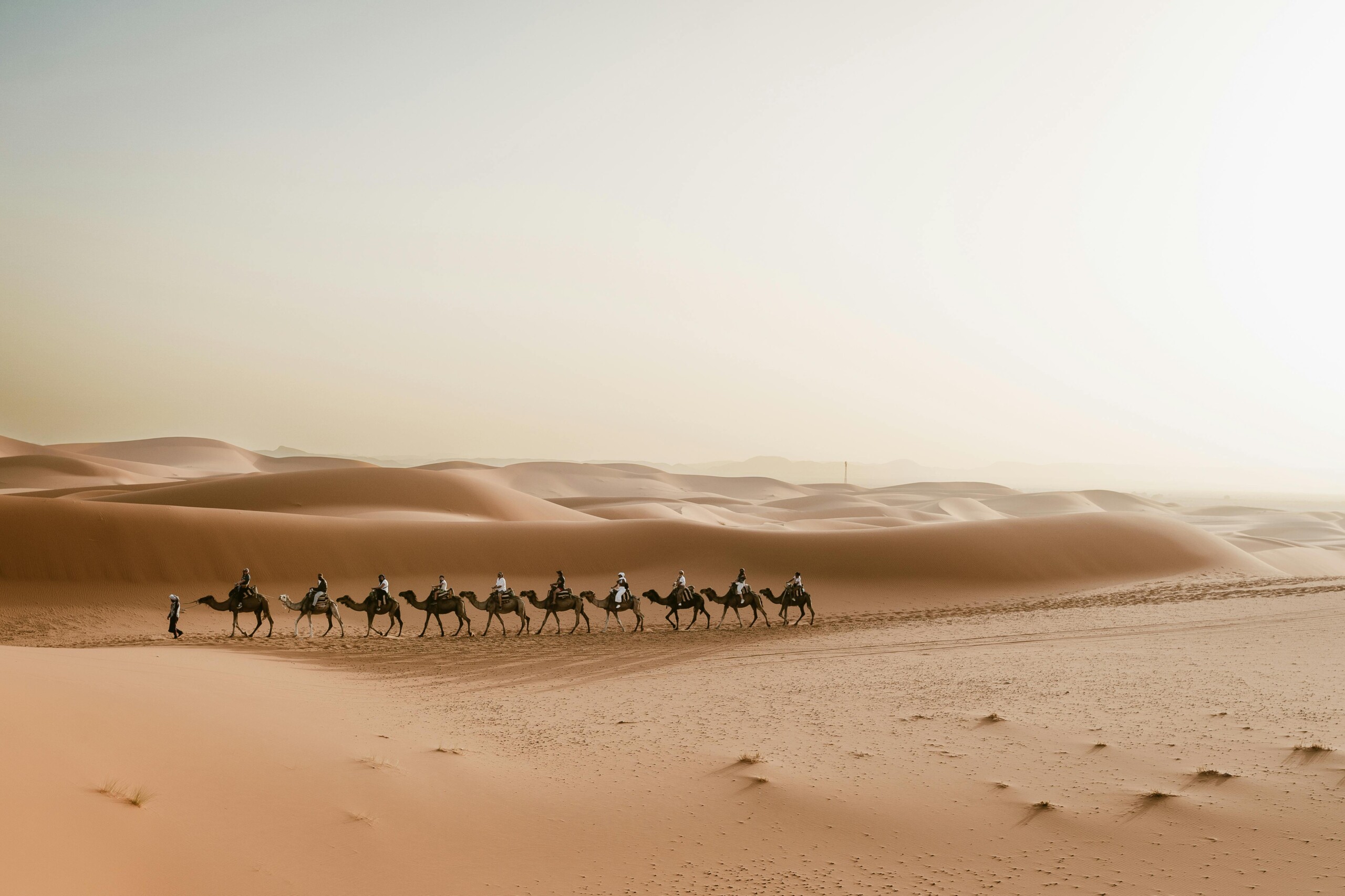
The drive continues through the palm groves of Touroug and Tinjdad, with a stop for lunch along the way, before reaching the golden dunes of Merzouga in the afternoon. From there, camels carry the group into the Erg Chebbi dunes, pausing atop a high dune to watch the sunset over the Sahara — a 4x4 transfer can be arranged instead if you'd prefer not to ride.
The night is spent in a luxury desert camp, with Berber hospitality, dinner, and drumming and dancing around the campfire.
- Todra Gorges walk
- Camel trek (or 4x4 alternative) into Erg Chebbi at sunset
- Overnight: luxury desert camp, Merzouga, dinner included
Merzouga to Fes via Erfoud, the Ziz Valley and the Middle Atlas
Leaving the desert after breakfast, the route passes through Rissani, once the ancient capital of the Tafilalet region and still home to a lively souk on Tuesdays, Thursdays and Sundays. A short stop follows in Erfoud, where fossilized marble is quarried and worked, with the option to visit a workshop.
From Erfoud, the drive follows the Ziz River north, with a stop for panoramic views over the Ziz Valley's palm groves, and free time for lunch around Midelt. The road then climbs into the cedar forests of the Middle Atlas, home to wild Barbary macaques often seen along the roadside, before passing through Ifrane — known for its alpine houses and cool climate.
The tour concludes with drop-off at any location in Fes, bringing the seven-day loop to a close.
- Rissani's souk and Erfoud's fossil workshops
- Ziz Valley and the Middle Atlas cedar forests
- Ifrane
- Trip ends: Fes
Is 7 Days Enough for This Route?
Yes, but it's an active itinerary, not a slow one. Covering all four imperial cities, Chefchaouen and a Sahara night in a week means two genuinely long driving days — Day 1 (Fes to Chefchaouen via Meknes and Volubilis) and the two-day return leg through the High Atlas, the Dades Valley and Merzouga back to Fes. Marrakech gets a full guided day, but Rabat, Casablanca and Chefchaouen are shorter visits by comparison. If you'd prefer a slower pace with more time in fewer places, ask us about an 8-10 day version of the same loop.
What Makes a Private 7-Day Morocco Journey Premium?
Not the hotel category alone. The accommodation on this route is hotels and riads, with one night in a luxury desert camp — comfortable and well-chosen, not five-star at every stop.
What's genuinely premium is structural: a private vehicle and driver for the full week, a local guide specifically where it adds value (Marrakech), and a route that can be adjusted — any city already visited can be swapped for extra time elsewhere.
- Privacy — your own vehicle and driver, not a shared coach
- Service — the same driver with you throughout
- Local guiding — a certified guide for the Marrakech day
- Personalization — the loop can be adjusted before booking
- Convenience — airport/riad pickup and drop-off included
- Comfort — air-conditioned private transport throughout
Private vs. Group Morocco Tour
Both formats have their place — this is a private tour, but here's an honest comparison.
| This Private Tour | Typical Group Tour | |
|---|---|---|
| Vehicle | Your party only | Shared with other travelers |
| Schedule | Can flex around your group | Fixed to the group's pace |
| Stops | Adjustable before booking | Fixed itinerary |
| Cost | Generally higher per person | Generally lower, shared costs |
How Much Does a Private 7-Day Morocco Tour from Fes Cost?
There's no single fixed price published for this route, because cost depends on group size, travel dates, accommodation category and vehicle. Request a quote with your dates and group size, and you'll receive a full breakdown to compare against other operators.
What's Included & What's Not
Included
- Private transport in an air-conditioned vehicle throughout
- English-speaking driver for the full 7 days
- 6 nights' accommodation (hotels, riads, luxury desert camp)
- Daily breakfast, and dinner on Days 5 and 6
- Local guide for the Marrakech sightseeing day
- Camel trek into the Merzouga dunes (4x4 alternative available)
- All airport / riad pickup and drop-off
Not Included
- International flights
- Lunches (free time is built in daily)
- Entrance fees to monuments and museums
- Majorelle Garden ticket (pre-booked online separately)
- Travel insurance
- Tips and personal expenses
The camel-free 4x4 alternative reflects our standard policy across itineraries — mention your preference when requesting your quote to confirm it for this specific route.
Where Do This Page's Facts Come From?
- UNESCO — Archaeological Site of Volubilis — official World Heritage listing.
- UNESCO — Ksar of Ait-Ben-Haddou — official World Heritage listing.
Frequently Asked Questions
Is 7 days enough for Morocco?
It's enough for a genuinely comprehensive loop from Fes — all four imperial cities, Chefchaouen, and one Sahara night — but it is an active week with two long driving days. Travelers who want a slower pace should look at an 8-10 day version instead.
Does this tour start and end in the same city?
Yes — it's a loop tour that begins and ends in Fes, so no one-way transfer is needed and you can fly in and out of the same airport.
Can you visit all four Imperial Cities in 7 days?
Yes. This route visits Fes, Meknes, Rabat and Marrakech — Morocco's four historic imperial capitals — within the 7-day loop.
How many nights are spent in the desert?
One night, at a luxury Berber camp in the Merzouga dunes, reached by camel trek at sunset on Day 6.
Is camel riding required in the Sahara?
The camel trek is part of the standard itinerary, but a 4x4 transfer to the desert camp can be arranged instead if you'd prefer not to ride.
Is the Majorelle Garden ticket included?
No — Majorelle Garden requires advance online booking directly through the garden, so the ticket itself isn't included, though the visit is built into Day 4's schedule.
Is this a private tour or a group tour?
It runs as a private, tailor-made tour with your own driver and vehicle throughout, so the schedule can flex around your group.
Can we skip Chefchaouen or Casablanca if we've already visited?
Yes, the route can be adjusted — any city already visited can be swapped out or replaced with extra time elsewhere on the loop.
Are entrance fees included?
No, entrance fees to monuments and museums are not included, and neither is the Majorelle Garden ticket.
How much does a private 7-day Morocco tour from Fes cost?
Cost depends on group size, travel dates and accommodation preference, so we provide a personalized quotation rather than a fixed listed price.
Is Marrakech guided on this tour?
Yes, a full day in Marrakech includes a local guide for the Bahia Palace, Ben Youssef Madrasa and the medina souks.
What is the best time of year for this tour?
Spring (March-May) and autumn (September-November) offer the most comfortable temperatures across the coast, the mountains and the desert. Summer is hot in Merzouga; winter can be cold in Ifrane and Chefchaouen.
How much driving is involved?
Two days involve significant driving: Day 1 (Fes to Chefchaouen via Meknes and Volubilis) and the two-day return leg through the High Atlas, Dades Valley and Sahara back to Fes. Most other days combine shorter drives with sightseeing stops.
Can the tour finish in Marrakech instead of returning to Fes?
Yes, a one-way version ending in Marrakech can be arranged on request instead of the standard Fes-to-Fes loop — ask about this when requesting your quote.
Is this itinerary suitable for families?
Yes, though the two longer driving days are worth discussing in advance if traveling with young children.
Related Itineraries
Start Planning Your Private Morocco Tour.
Get a tailor-made quote for the 7-day Morocco tour, or ask us anything about the route, the cities, or the desert camp.