
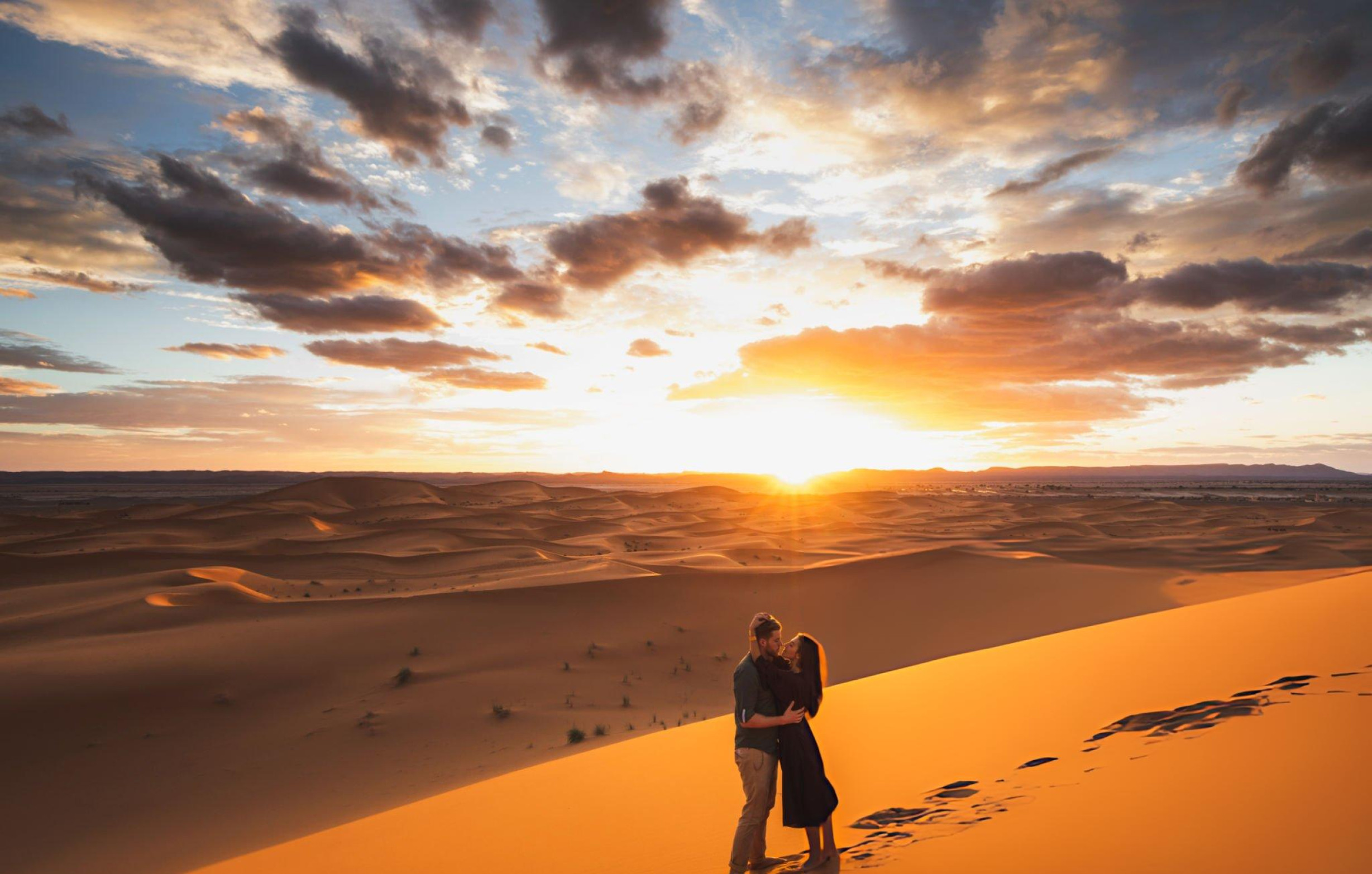
Private Morocco Honeymoon Tours & Luxury Romantic Packages
Imperial cities, boutique riads and a private Sahara camp — combined into one itinerary built around your pace, not a group's.
Published September 19, 2026 · Updated September 19, 2026
A Morocco honeymoon tour is a private, multi-day itinerary built around one couple rather than a fixed group schedule. It can combine imperial cities, the High Atlas, the Sahara and the Atlantic coast, or stay focused on a single region if your time is limited. Because the vehicle, driver and daily pace belong to you alone, stops can run longer where you want them to and shorter where you don't — the itinerary below is a starting point to adapt, not a fixed package.
Honeymoon At a Glance
- Tour style
- Private and tailor-made
- Recommended duration
- 8–14 days
- Short romantic escape
- 5–7 days
- Starting cities
- Casablanca, Marrakech, Tangier or Fes
- Main experiences
- Historic cities, Atlas Mountains, Sahara and coast
- Accommodation
- Boutique riads, hotels and private desert camps
- Transportation
- Private air-conditioned vehicle
- Best suited to
- Honeymoons, anniversaries and couples
- Camel-free option
- Available on request
- Customization
- Route, pace, stays and experiences
- How to book
- Request a personalized proposal
Why Choose Morocco for Your Honeymoon?
Morocco suits couples who want contrast in one trip — historic medinas, mountain scenery, desert dunes and Atlantic coastline are all within a few hours' drive of each other, so a single itinerary can move between very different landscapes without long flights in between.
That contrast is the appeal: a morning in a walled medina, an afternoon crossing the High Atlas, and a night under a clear desert sky are genuinely different experiences, and few countries let you string them together this easily. Traditional riads add a private, courtyard-centered style of accommodation that's distinct from a standard hotel stay, and the Atlantic coast offers a slower final stretch for couples who want to end the trip at a gentler pace. Morocco isn't the least expensive honeymoon destination, and it isn't equally suited to every couple — travelers who want a single beach resort for two weeks will likely be better served elsewhere.
What Makes a Private Morocco Honeymoon Different?
On a private tour, the vehicle, driver and schedule belong to your two-person party for the whole trip. That changes several practical things: departure times shift to suit you, sightseeing stops can run long or be skipped, and accommodation is chosen for your preferences rather than a group rate. Slower mornings, hammam or spa time, dietary notes, and honeymoon or anniversary mentions can all be built into the plan in advance, along with a camel-free desert alternative if you'd prefer it.
| Feature | Private honeymoon | Standard group tour |
|---|---|---|
| Transportation | Private | Shared |
| Daily schedule | Flexible | Fixed |
| Accommodation | Selected around preferences | Standardized |
| Sightseeing | Personalized | Group schedule |
| Couple time | Easier to protect | Limited by timetable |
| Route | Customizable | Predetermined |
| Special requests | Considered individually | Limited |
| Price | Personalized quote | Usually fixed |
Neither format is wrong — a group tour can suit couples on a fixed budget who don't mind a shared schedule. A private honeymoon costs more per couple but buys flexible stops, dietary accommodation and the ability to protect quiet time together.
The Most Romantic Places in Morocco
Marrakech
Marrakech offers the widest choice of boutique riads in the country, many built around a quiet interior courtyard just steps from the souks. Rooftop dinners, hammam appointments and garden visits (the Jardin Majorelle among them) fill an afternoon easily. Two to three nights suits most couples — enough time for the medina and a slower pace, without the city dominating a short trip. The main practical limitation is heat in peak summer, when midday sightseeing is best kept short. See Private Tours from Marrakech.
The High Atlas Mountains
An hour or two outside Marrakech, the High Atlas trades city noise for terraced villages and mountain air. A single overnight or even a day trip suits couples who want quiet scenery without a full trekking itinerary; gentle walks and a scenic drive are enough for most honeymooners. Road conditions and weather can affect pacing here more than in the cities, so build in some flexibility.
Skoura and the Valley of Roses
South of the Atlas, the palm groves and kasbah-style guesthouses around Skoura offer a slower, rural counterpoint to the cities — one night here works well as a stopover between the mountains and the desert rather than as a standalone destination.
Ait Ben Haddou and Ouarzazate
Ait Ben Haddou is a fortified earthen village (a ksar) that UNESCO describes as "a striking example of the architecture of southern Morocco". A stop of an hour or two on the way to or from the desert is typical rather than an overnight stay, since nearby Ouarzazate has more developed accommodation.
Merzouga and Erg Chebbi
The Sahara stop most honeymoon itineraries build toward: dune scenery, a private en-suite desert camp, sunset and sunrise over the sand, and a camel-free 4x4 alternative if you'd prefer it. Two nights rather than one lets you settle in properly instead of arriving near sunset and leaving after breakfast. The main limitation is the drive itself — Merzouga is a full travel day from Marrakech or Fes, which is worth factoring into a short itinerary.
Fes
Fes has one of the world's largest car-free medinas, which UNESCO notes "has retained its status as the country's cultural and spiritual centre". A private local guide is worth arranging here — the medina's layout is genuinely disorienting on your own, and a guide adds context to the tanneries, madrasas and craft workshops. One to two nights is typical.
Chefchaouen
The blue-washed lanes of Chefchaouen, set in the Rif Mountains, suit a slower single day or overnight of photography and unhurried walking rather than a packed sightseeing schedule. It sits naturally on a route between Tangier and Fes.
Essaouira
On the Atlantic coast, Essaouira's fortified medina has long served, as UNESCO puts it, as a link "linking Morocco and its Saharan hinterland with Europe and the rest of the world". Cooler sea air, fresh seafood and beach walks make it a good closing stop on longer itineraries, though it adds a full extra travel day if paired with the Sahara.
Best Morocco Honeymoon Itineraries
The routes below are starting points, not fixed packages — every one can be adjusted for your dates, arrival city and pace.
5-Day Romantic Morocco Escape
Best for couples with limited time. On five days, we recommend focusing on one region — typically Marrakech and the High Atlas — rather than trying to add the Sahara, which needs a full travel day each way. Customize This Honeymoon
7-Day Private Morocco Honeymoon
Combines Marrakech, the High Atlas and either a shorter desert loop or the coast, with one hotel change fewer than the longer routes below. Best for couples who want the Sahara without a rushed pace. Customize This Honeymoon
9-Day Morocco Honeymoon from Casablanca
Starts in Casablanca, moves north through Chefchaouen and Fes, then south to the Sahara before finishing in Marrakech. This route only paces realistically at 9 days or more — attempting it in less compresses the driving days uncomfortably.
10-Day Luxury Morocco Honeymoon
Ten days is usually the shortest length that combines imperial cities, the Sahara and Marrakech while still leaving some slower, unscheduled time together.
12-Day Morocco Honeymoon
Adds the northern cities and Fes with better pacing than the 9-day route, plus more time in the desert and valleys before Marrakech.
14-Day Grand Morocco Honeymoon
The most complete first-time route: imperial cities, the Sahara, Atlas landscapes, Marrakech and Essaouira, at a pace with fewer back-to-back long driving days than the shorter itineraries above. See our related Morocco Grand Tours guide for the broader route logic this length draws on.
Choosing the Right Honeymoon Length
| Duration | Best For | Possible Experience | Pace |
|---|---|---|---|
| 5–6 days | Short escape | Marrakech plus Atlas, coast or desert | Focused |
| 7–8 days | Couples with limited leave | Marrakech, mountains and a selected desert route | Active |
| 9–10 days | First-time visitors | Cities, Sahara and Marrakech | Balanced |
| 11–12 days | Couples wanting more rest | North, Fes, desert and Marrakech | Comfortable |
| 13–14 days | Comprehensive honeymoon | Cities, desert, mountains and coast | Well paced |
| 15+ days | Slow honeymoon travel | Longer stays, fewer rushed transfers | Relaxed |
Adding destinations to a short itinerary usually costs more in comfort than it adds in sightseeing — route design and pacing matter more than the number of stops.
Luxury Riads, Hotels and Desert Camps
"Riad" describes a traditional courtyard house, not a star rating — a riad's character comes from its architecture and atmosphere, and quality varies property to property. City-hotel luxury (larger rooms, modern amenities, often a pool) is a different experience from desert-camp luxury (a private en-suite tent, but no pool and sometimes limited heating or cooling), and neither should be assumed to include the other.
- Atmosphere, location and privacy of the property
- Room category and whether the bathroom is private
- Heating and air-conditioning — confirmed for your specific dates, not assumed
- Pool availability, which is often seasonal
- Accessibility, given that many riads have stairs and no elevator
- Distance from the sites you want to visit
We name the proposed properties in your written quotation rather than a generic category, so there's nothing to guess at before you book.
A Romantic Night in the Sahara
A typical desert night runs: a scenic drive into Erg Chebbi, a transfer to camp (by camel or 4x4), a sunset over the dunes, dinner at the camp (often with music, where the camp offers it), stargazing away from city light, sunrise the next morning, and breakfast before departure. We don't guarantee a completely silent camp, cloudless skies, exclusive access to a stretch of dune, or a fully private camp unless you've specifically booked one — conditions vary by night and by camp.
Camel Ride or Camel-Free Desert Experience?
Both options are available and neither is pushed over the other. A camel trek to camp is the traditional approach; a private 4x4 transfer is the standard camel-free alternative, and it's a straightforward request if you're concerned about animal welfare, motion, mobility or simply prefer it.
Romantic Experiences You Can Add
Every item below is subject to availability and its own quotation — none is included automatically.
- Private dinner (where the property offers it)
- Couples' hammam or spa appointment
- Professional photoshoot
- Cooking class
- Food tour
- Gentle mountain walk
- Hot-air balloon flight (where operational)
- Private guide in Marrakech or Fes
- Extra night in the Sahara
- Anniversary room note
Honeymoon Planning for Different Couples
Adventure-Loving Couples
Add mountain walks, a longer desert stay or a camel trek rather than a 4x4 transfer, and build in more driving days for a wider route.
Couples Seeking Relaxation
Favor fewer stops, more nights per location, and coastal time in Essaouira over a packed multi-city route.
Luxury-Focused Honeymooners
Prioritize named boutique properties and a higher desert-camp category — we'll confirm exact rooms and amenities before booking rather than a vague "luxury" label.
Mature Couples and Second Honeymoons
Fewer long driving days and more time in fewer places, with pacing adjusted accordingly.
Couples Who Prefer Not to Ride Camels
The 4x4 desert transfer above is the standard alternative — just let us know when planning.
Couples with Dietary Requirements
Shared in advance, most hotels and camps can accommodate common requirements; options narrow in smaller towns, so flag specifics early.
LGBTQ+ Couples
Consensual same-sex relations are illegal under Moroccan law, and public attitudes vary by region and setting. Couples should check current, official guidance before traveling — the U.S. Department of State's guidance for LGBTQI travelers is a useful starting point, and travelers from other countries should consult their own government's equivalent advisory. We can't make safety guarantees, but we're glad to discuss discretion and planning honestly if you reach out directly.
When Is the Best Time for a Morocco Honeymoon?
Spring (March–May) and autumn (September–November) generally bring the most comfortable temperatures across the coast, cities, mountains and desert. Summer (June–August) runs hot inland and in the Sahara; winter (December–February) is mild in the cities but cold at night in the mountains and desert. These are general patterns, not a guaranteed forecast — check current conditions closer to your travel dates.
How Much Does a Morocco Honeymoon Cost?
There's no single published price. Cost depends on trip duration, travel dates, accommodation category, room selection, vehicle type, arrival and departure airports, number of guides, desert-camp category, included meals and optional experiences.
Request a price built around your actual plans. Request Our Personalized Honeymoon Proposal →
What Should a Morocco Honeymoon Package Include?
Typically Included
- Private transportation and English-speaking driver
- Fuel, tolls and parking
- Selected accommodation
- Breakfast daily
- Dinner and breakfast at the desert camp
- Airport transfers where specified
- Licensed local guides where listed
- Camel-free transfer where requested
- Pre-trip itinerary planning
Typically Excluded
- International flights
- Travel insurance
- Most lunches and drinks
- Tips
- Personal purchases
- Unlisted entrance fees
- Unspecified activities
- Spa treatments unless listed
Your written proposal and booking confirmation determine the final inclusions.
How to Choose a Morocco Honeymoon Company
- Confirm the journey is genuinely private
- Request realistic driving times, not just a route map
- Ask for named accommodations, not a vague category
- Verify room categories and desert-tent type
- Ask about heating or cooling for your dates
- Request a detailed inclusions list
- Check cancellation conditions
- Confirm the vehicle category
- Ask who provides in-country support during the trip
- Ask about camel-free alternatives
Frequently Asked Questions
Is Morocco a good honeymoon destination?
Yes, for couples who want a mix of culture, scenery and something more distinctive than a beach-only trip. Morocco combines historic medinas, mountain scenery, Sahara dunes and Atlantic coastline within a few hours' drive of each other, and a private itinerary lets you weight the trip toward whichever of those you care about most.
Are Morocco honeymoon tours private?
On this site, yes — every honeymoon itinerary is a private tour with your own vehicle, driver and schedule. There are no shared group departures, so start times, stops and pacing are set around your two schedules, not a group's.
How many days do we need for a Morocco honeymoon?
Most couples find 8 to 14 days enough to combine cities, the Sahara and either the mountains or the coast without feeling rushed. A 5-7 day trip works well if you'd rather focus on one region in more depth than cover the whole country quickly.
What is the best Morocco honeymoon itinerary?
There isn't a single best route — it depends on your days available, arrival city and whether you'd rather prioritize the Sahara, the coast, or a slower single-region trip. The comparisons on this page are meant to help you narrow it down before we build a personalized version.
How much does a Morocco honeymoon cost?
There's no fixed price — cost depends on trip length, accommodation category, vehicle type, season, number of desert-camp nights and which optional experiences you add. We provide a written, itemized quotation once we know your dates and preferences rather than publishing a generic figure.
What is included in a honeymoon package?
Typical inclusions are the private vehicle and driver, fuel and tolls, selected accommodation, breakfast daily, dinner and breakfast at the desert camp, and airport transfers and local guides where specified. International flights, most lunches and drinks, tips and optional experiences are usually excluded — your written proposal confirms the exact list.
When is the best time to honeymoon in Morocco?
Spring (March–May) and autumn (September–November) generally offer the most comfortable temperatures across the cities, mountains and desert. Summer runs hot inland and in the Sahara, and winter is mild in the cities but cold at night in the mountains and desert.
Is Marrakech suitable for honeymooners?
Yes — Marrakech has a wide range of boutique riads, gardens, hammams and rooftop restaurants, and works well either as a standalone short escape or as the start or end point of a longer route.
Is the Sahara worth including?
For most couples planning more than 7 days, yes — a night or two near Merzouga adds a genuinely different landscape and pace to the trip. On a very short itinerary it can make the schedule feel rushed, so it's worth weighing against a slower single-region trip instead.
Do luxury desert camps have private bathrooms?
Higher-category desert camps typically offer private en-suite tents; simpler camps may use shared facilities. We confirm the exact tent type and bathroom setup for your selected camp before you book.
Can we visit the desert without riding camels?
Yes — a private 4x4 transfer to the desert camp is a standard alternative to camel trekking and can be requested for comfort, mobility or personal preference.
Can we customize the itinerary?
Yes. Route, pace, number of desert nights, hotel category and included experiences can all be adjusted around your dates and interests rather than fixed to a template.
Can we include free days?
Yes — unscheduled days or slower mornings can be built into the itinerary, particularly on trips of 9 days or longer where the pace allows it.
Can dietary requirements be accommodated?
In most cases yes, when shared in advance so hotels and desert camps can prepare accordingly; options narrow in smaller towns, so it's worth flagging specific requirements before booking.
What type of vehicle is provided?
A private air-conditioned 4x4 or premium minivan with an English-speaking driver, sized to your party and confirmed at the quotation stage.
Can we start in Casablanca and finish in Marrakech?
Yes — open-jaw routes starting and ending in different cities are common on longer honeymoon itineraries and can simplify your flight planning.
Can we combine the desert and Essaouira?
Yes, on itineraries of around 12 days or longer — combining the Sahara and the Atlantic coast in a shorter trip usually means long driving days, so we'll flag the realistic pacing when we design your route.
Are spa treatments included?
Not by default. A couples' hammam or spa appointment can be added where the property offers it, subject to availability and its own cost.
Should we book travel insurance?
Yes, travel insurance is not included in our packages and we recommend arranging your own cover before departure.
How do we reserve our private honeymoon?
Share your travel dates, number of days and accommodation preference through our contact page or WhatsApp, and we'll prepare a personalized itinerary and written quotation from there.
Sources & Further Reading
UNESCO World Heritage Centre — Ksar of Ait-Ben-Haddou · UNESCO World Heritage Centre — Medina of Fez · UNESCO World Heritage Centre — Medina of Essaouira · U.S. Department of State — LGBTQI Travelers (accessed September 2026)
Design Our Morocco Honeymoon
Share whatever you already know — dates, arrival and departure cities, hotel category, pace and main interests — and we'll shape a personalized proposal around it, with direct local support before and during the trip.