
18-Day Morocco Grand Tour from Marrakech
A private 18-day circuit through Morocco's imperial cities, Atlas valleys, Erg Chebbi Sahara, northern towns and Atlantic coast — including Ait Bougmez, Oualidia and Safi, places most Grand Tours skip entirely.
Reviewed by Aziz Karaoui, Co-Founder & Morocco Travel Expert at Desert Morocco Tour · Updated September 13, 2026
An 18-Day Circuit, Not a Sahara Tour With Extras
The 18-Day Morocco Grand Tour from Marrakech is a private, 17-night itinerary covering the High Atlas Mountains, the Sahara Desert, Fes, Chefchaouen, Tangier, Morocco's imperial cities and the Atlantic coast before returning to Marrakech. Desert Morocco Tour is a Morocco-based operator specializing in private, tailor-made journeys — this is our longest standard Grand Tour, built for travelers who have the time to see Morocco's regions in depth rather than skimming the highlights.
What sets this route apart from our 10, 12 and 14-day circuits isn't just extra days tacked onto a Sahara loop — it's genuine additions most Grand Morocco itineraries don't include: the Ait Bougmez valley in the High Atlas, the Atlantic lagoon town of Oualidia, and the ceramics town of Safi, alongside full free days in Chefchaouen and Essaouira. Marrakech and Fes each include a full guided city day with a certified local guide; the rest of the route runs at your own pace with your private driver.
Request Your Private Quote
Share your travel dates, group size and accommodation preference, and you'll receive a tailored price for this 18-day route — or a shorter or longer version of the same journey.
Why Spend 18 Days Exploring Morocco?
A 10-day tour covers Marrakech, the Sahara and Fes at a fast pace. A 12-day version balances the classic circuit. Fourteen days adds real time in Chefchaouen and a second Sahara night. Eighteen days is where a route can add places that don't fit into a shorter trip at all — Ait Bougmez, Oualidia, Safi — without cutting the standard highlights or free days. If your time is more limited, our shorter Grand Tours cover the essentials well; this route is for travelers who want the fuller picture.
Jump to a day
- 1Marrakech Arrival
- 2Marrakech Tour
- 3Ait Ben Haddou
- 4Ait Bougmez · Skoura
- 5Dades Hike
- 6Todra · Merzouga
- 7Sahara Full Day
- 8Ziz Valley · Fes
- 9Fes Guided Day
- 10Meknes · Chefchaouen
- 11Chefchaouen Free Day
- 12Tangier
- 13Asilah · Rabat
- 14Casablanca · Oualidia
- 15Safi · Essaouira
- 16Essaouira Free Day
- 17Return to Marrakech
- 18Departure
What You'll Actually Experience
Guided Marrakech
A full day with a certified local guide through the medina's landmarks.
Ait Ben Haddou
A guided visit to the UNESCO-listed fortified ksar.
Ait Bougmez Valley
A rural High Atlas valley most Grand Tours never reach.
Skoura's Palm Oasis
Kasbah architecture among the palm groves.
Guided Dades Hike
Walking between red canyons and Berber villages.
Todra Gorges
A walk between the region's towering canyon walls.
Two Nights, Erg Chebbi
A full desert day between two nights at camp, not a rushed overnight.
Khamlia & Gnawa Music
A respectful introduction to a Gnawa community near Merzouga.
Guided Fes
A full day through the medina with a certified local guide.
A Full Day, Chefchaouen
Unhurried time in the blue city, not a single overnight.
Tangier & Asilah
Cape Spartel, the old medina, and Asilah's murals.
Oualidia & Safi
An Atlantic lagoon and a historic ceramics town, both rarely included.
How Does the 18-Day Itinerary Unfold?
Every night's accommodation is confirmed in advance — this is a guide to how the days unfold, not a loose outline.
Arrival in Marrakech
Your private driver meets you at Marrakech Menara Airport and takes you to your riad. Depending on arrival time, there's room for a first walk through Jemaa el-Fna and the nearby souks, or simply time to rest. This is a comfortable arrival day, not a packed one.
- Private airport pickup
- Transfer to your riad
- Optional first walk, depending on arrival time
- Overnight: riad, Marrakech
Guided Day in Marrakech
A certified local guide leads a full day through Marrakech's landmarks: the Koutoubia Mosque exterior, the Bahia Palace, and the Saadian Tombs, followed by the medina and souks. The Majorelle Garden and Jemaa el-Fna's evening atmosphere round out the day.
- Guided visit: Koutoubia exterior, Bahia Palace, Saadian Tombs
- Medina and souks
- Majorelle Garden and Jemaa el-Fna
- Overnight: riad, Marrakech
Marrakech — High Atlas — Ait Ben Haddou — Ouarzazate
The road climbs over the High Atlas via the Tizi n'Tichka pass, leaving Marrakech's flat Haouz plain behind for mountain switchbacks and Berber villages. A guided visit to Ait Ben Haddou takes in its earthen architecture and history as a stop on the historic caravan route between the Sahara and Marrakech — not only its more recent film appearances. The day ends in Ouarzazate.
Called "a striking example of the architecture of southern Morocco" by UNESCO World Heritage
- Tizi n'Tichka pass over the High Atlas
- Guided visit to Ait Ben Haddou
- Overnight: hotel, Ouarzazate
Ouarzazate — Ait Bougmez Valley — Skoura
This is the longest and most demanding driving day on the route. Ait Bougmez, known locally as the "Happy Valley," sits deep in the High Atlas — a rural valley of terraced fields and Amazigh villages reached by mountain roads rather than a direct highway. Reaching it from Ouarzazate, spending meaningful time there, and continuing on to Skoura the same day is a full day of driving with limited time actually in the valley.
Because of the distances involved, if you'd like more time to actually explore Ait Bougmez rather than pass through it, ask about adding an overnight there when you request your quote — it extends the trip by a day but turns a long transit day into two more comfortable ones.
- Long mountain drive to Ait Bougmez Valley
- Time in the valley — villages, terraced fields, a short walk
- Continue to the Skoura palm oasis
- Overnight: guesthouse, Skoura, dinner included
Skoura — Dades Valley
A morning in the Skoura oasis among its palm groves and historic kasbahs, before continuing to the Dades Valley. In the afternoon, a guided hike leads between red-rock canyons, small Berber villages and cultivated terraces — this hike is included as part of the day, led by your driver-guide rather than a separate specialist mountain guide.
- Skoura's palm oasis and kasbah architecture
- Guided hike through the Dades Valley
- Overnight: lodge, Dades Valley, dinner included
Dades Valley — Todra Gorges — Erfoud — Merzouga
A walk through the Todra Gorges takes in canyon walls that narrow dramatically overhead — a popular spot with rock climbers. Continuing through Erfoud, known for its fossil trade, the landscape opens onto the pre-Saharan plains before reaching Merzouga. A camel ride carries you into the Erg Chebbi dunes for sunset — a 4x4 transfer can replace this if you'd prefer not to ride — followed by dinner at your luxury desert camp.
- Todra Gorges walk
- Erfoud's fossil trade
- Camel ride (or 4x4 alternative) into Erg Chebbi
- Overnight: luxury desert camp, Merzouga, dinner included
Full Day: Merzouga & the Sahara
An optional sunrise over the dunes, then a full day exploring the wider desert region by 4x4: Khamlia, home to a Gnawa musical tradition with roots in West Africa, and a stop with a local nomadic family, approached as a respectful visit rather than a staged photo stop. Sandboarding is available in the afternoon before a second night at the same desert camp.
Gnawa is listed on UNESCO's Representative List of the Intangible Cultural Heritage of Humanity
- Optional dune sunrise
- 4x4 exploration around Erg Chebbi
- Khamlia village and Gnawa music
- Nomad family visit; sandboarding available
- Overnight: luxury desert camp, Merzouga, dinner included
Merzouga — Ziz Valley — Midelt — Azrou — Fes
Another long driving day. The Ziz Valley's palm groves and fortified villages give way to the Middle Atlas around Midelt, then the Azrou cedar forest, where Barbary macaques are often seen near the road, before Fes is reached in the evening.
This is a full transfer day with several stops — expect most of the day spent traveling rather than sightseeing on foot.
- Ziz Valley palm groves
- Middle Atlas and Azrou cedar forest
- Overnight: riad, Fes
Guided Day in Fes
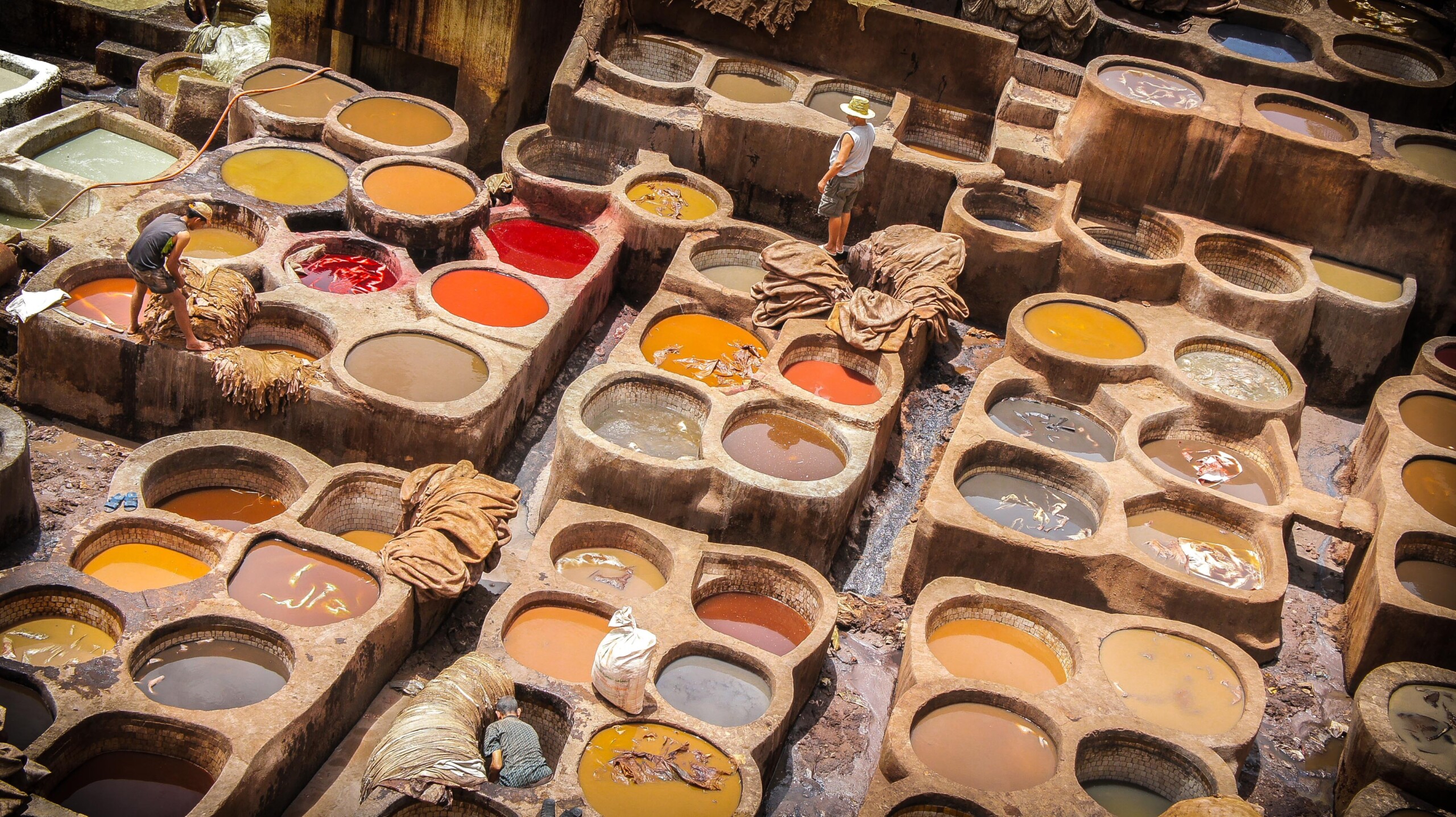
A certified local guide leads a full day through Fes el-Bali, one of the world's largest car-free urban medinas: the Chouara Tanneries, the Nejjarine Fountain, artisan workshops, and the exterior of the Al Quaraouiyine mosque and university — entry is generally reserved for worshippers and students, so the visit centers on its history and architecture from outside.
Fes has "retained its status as the country's cultural and spiritual centre" — UNESCO World Heritage
- Guided walking tour of Fes el-Bali
- Chouara Tanneries, Nejjarine Fountain, artisan workshops
- Al Quaraouiyine exterior
- Overnight: riad, Fes
Fes — Meknes — Volubilis — Chefchaouen
Meknes brings a stop at the Bab Mansour gate and El Hedim Square, plus the Heri es-Souani granaries — the historic royal storehouses, now a ruin open to visitors rather than functioning stables. Volubilis follows, with a walk among Morocco's best-preserved Roman mosaics and archways. The day ends in Chefchaouen, in the Rif Mountains.
Volubilis is inscribed as "an exceptionally well preserved example of a large Roman colonial town" — UNESCO World Heritage
- Bab Mansour and the Heri es-Souani granaries, Meknes
- Roman ruins of Volubilis
- Overnight: guesthouse, Chefchaouen
Free Day in Chefchaouen
A full day at your own pace: the blue-painted medina, a quiet café, craft shops, or a hike to the Spanish Mosque viewpoint above town. On a private tour, a day with nothing scheduled is as much a feature as another guided visit — this is where the trip deliberately slows down after several driving days.
- Free day in the blue medina
- Optional hike to the Spanish Mosque viewpoint
- Overnight: guesthouse, Chefchaouen
Chefchaouen — Tangier
Tangier sits where the Rif Mountains meet the Strait of Gibraltar, close to the point traditionally considered the boundary between the Atlantic and Mediterranean. Cape Spartel offers views out over the strait, and the Hercules Caves nearby add a stop with genuine legend attached. The evening is free to walk the old medina overlooking the water.
- Cape Spartel and the Hercules Caves
- Free evening in Tangier's medina
- Overnight: hotel, Tangier
Tangier — Asilah — Rabat
Asilah's fortified medina and Portuguese-era ramparts are covered in murals from its annual arts festival, giving it an unusually creative character among Morocco's coastal towns. Continuing south to Rabat, the day covers the Hassan Tower, the Mausoleum of Mohammed V, and the Kasbah of the Oudayas overlooking the Bou Regreg river.
- Asilah's medina and murals
- Hassan Tower and Mausoleum of Mohammed V, Rabat
- Kasbah of the Oudayas
- Overnight: riad, Rabat
Rabat — Casablanca — Oualidia
The Hassan II Mosque, built out over the Atlantic and one of the few mosques in Morocco open to non-Muslim visitors, precedes a walk along Casablanca's Corniche. From there the route turns quiet: Oualidia is a small lagoon town known for oyster farming and calm, shallow water — a deliberate contrast to Casablanca's scale before the day ends.
- Hassan II Mosque and the Corniche, Casablanca
- Arrival in the Oualidia lagoon
- Overnight: guesthouse, Oualidia
Oualidia — Safi — Essaouira
Safi has been a center of Moroccan ceramics production for generations, and a stop at the potters' quarter and the old fortress adds context most coastal routes skip entirely. The road continues along the ocean to Essaouira, a walkable medina with a genuinely different, more relaxed rhythm than Marrakech or the imperial cities.
- Safi's ceramics quarter and old fortress
- Coastal drive to Essaouira
- Overnight: riad, Essaouira
Free Day in Essaouira
A full free day: the medina, the Skala ramparts, the fishing harbor, or the beach. Optional activities — surfing, horse riding, camel riding, quad biking — can be arranged but aren't part of the standard itinerary. After 15 days of driving and sightseeing, this is deliberate decompression before the return to Marrakech.
- Free day: medina, Skala ramparts, harbor, beach
- Optional: surfing, horse riding, quad biking
- Overnight: riad, Essaouira
Essaouira — Marrakech
The return drive passes through argan forests — the tree only grows naturally in this part of Morocco, and a stop at a women's cooperative shows the traditional hand-pressing process behind the oil. The evening in Marrakech is free for shopping, a hammam, or a final dinner in the medina.
- Argan forest and cooperative visit
- Free evening in Marrakech
- Overnight: riad, Marrakech
Departure from Marrakech
Depending on your flight time, there may be a final window for the medina before your private transfer to Marrakech Airport, bringing the 18-day journey to a close.
- Free time depending on flight schedule
- Private transfer to Marrakech Airport
- Trip ends: Marrakech
Why Include Ait Bougmez in a Grand Morocco Tour?
Most Grand Morocco circuits never reach Ait Bougmez — it's a rural valley deep in the High Atlas, reached by mountain roads rather than a direct highway, with terraced fields and Amazigh villages that don't feature in the standard Marrakech-Sahara loop. Including it adds a genuinely different register to the trip: agricultural rather than imperial, quiet rather than monumental. The trade-off is honest, though — it's a long day to reach and requires a full transit day either side, which is exactly why we flag the driving distance on Day 4 rather than glossing over it.
Why Spend Two Nights in the Sahara?
A single overnight in Merzouga only really allows a sunset arrival and a sunrise departure. The second night on this itinerary exists specifically to leave a full day for the things that make the Sahara memorable beyond the dunes themselves — Khamlia's music, a nomad family visit, and time to actually explore the desert by 4x4 rather than rushing straight back out the next morning.
Why Stop in Oualidia?
Most Casablanca-to-Essaouira routes skip straight past the coast in between. Oualidia is a small lagoon town known for oyster farming and calm, shallow water — a natural place to slow down after Casablanca's size and before Essaouira's more well-known charm. It's less a headline destination than a deliberate pause in the route.
What Does "Private" Mean on This 18-Day Tour?
A private tour means a vehicle and driver dedicated to your travel party for the full 18 days — not a shared coach, and not a fixed group departure calendar. Stops, pace and free-day activities are yours to set.
It doesn't mean private access to monuments — Ait Ben Haddou, Volubilis and the medinas remain public sites open to any visitor. What's private is the vehicle, the schedule, and the ability to adjust the plan before you travel.
- Private vehicle and driver, your travel party only
- Certified local guides in Marrakech and Fes specifically
- Flexible stops and pace outside the two guided city days
- Accommodation and activities can be adjusted before booking
- Private airport transfers in Marrakech, both directions
What Does "Premium" Mean Here?
This isn't a luxury tour simply because it includes a desert camp. The accommodation mix — riads, guesthouses, mountain lodges — is comfortable rather than uniformly five-star. What's premium is structural: privacy throughout, genuine free days in Chefchaouen and Essaouira, thoughtful routing that reaches places most itineraries skip, and local expertise where it counts (Marrakech and Fes). If you'd like to upgrade specific nights to a boutique, 4-star or 5-star category where available, mention it when requesting your quote.
Accommodation During the 18-Day Tour
The Mix
Riads in the cities, a guesthouse in the Skoura oasis, a lodge in the Dades Valley, guesthouses in Oualidia and along the coast, and a luxury desert camp near Merzouga for two nights. Breakfast and dinner are included throughout.
Upgrades & Preferences
Exact properties depend on availability, your travel dates and preferred category. If you'd like an upgrade for particular nights, ask about it when requesting your quote.
What's Included & What's Not
Optional activities mentioned in the itinerary above — hammam, surfing, horse riding, quad biking — are not part of the standard inclusions below unless specifically added to your proposal.
Included
- Private, air-conditioned 4WD or minivan
- Private driver for the full itinerary
- Daily accommodation pick-up and drop-off with luggage service
- 17 nights' accommodation as specified above
- Half-board: breakfast and dinner daily
- Entrance fees for the sites specifically listed in this itinerary's confirmed inclusions
- Certified local guide in Marrakech for a full-day city tour
- Certified local guide in Fes for the historic medina
- Guided visit of Ait Ben Haddou
- Guided hike in the Dades Valley
- 4x4 desert exploration around Merzouga
- Camel trek in the Sahara Desert (4x4 alternative available)
- Sandboarding in the dunes
Not Included
- International flights to/from Morocco
- Travel insurance
- Lunches
- Tipping
- Personal expenses
- Optional activities not specifically added to your proposal
- Entrance fees not specifically listed in your confirmed inclusions
Chefchaouen is a free day on this itinerary, not a guided city tour — if you'd like a local guide there too, mention it when requesting your quote.
Where Do This Page's Facts Come From?
- UNESCO — Ksar of Ait-Ben-Haddou — official World Heritage listing.
- UNESCO — Medina of Fez — official World Heritage listing.
- UNESCO — Archaeological Site of Volubilis — official World Heritage listing.
- UNESCO — Gnawa, Intangible Cultural Heritage — official listing.
Is This 18-Day Morocco Tour Right for You?
This route suits first-time visitors with plenty of time, couples, families, small private groups, mature travelers and cultural travelers who want a genuinely comprehensive Morocco trip rather than a highlights package.
Choose a shorter itinerary if your priority is Marrakech, the Sahara and Fes (10-12 days), or if you want the major highlights including the north without the more remote additions (around 14 days). Choose this 18-day route if you specifically want Ait Bougmez, Oualidia and Safi alongside everything else — and are comfortable with two genuinely long driving days (Day 4 and Day 8) in exchange for reaching them.
10, 12, 14 or 18 Days?
| Length | What It Covers |
|---|---|
| 10-12 days | Essential highlights: Marrakech, the Sahara, Fes, the classic circuit |
| ~14 days | A comprehensive Grand Morocco journey including the north |
| 18 days | Everything above, plus Ait Bougmez, Oualidia and Safi, at a slower pace |
How Much Does an 18-Day Private Morocco Tour Cost?
There's no single fixed price published for this route, because cost depends on group size, travel dates, accommodation category, vehicle, and any optional activities you add. Request a quote with your dates and group size, and you'll receive a full breakdown to compare against other operators.
Make This 18-Day Tour Your Own
This itinerary is a starting point. It can be adjusted around accommodation category, an added overnight in Ait Bougmez to ease Day 4's driving, a camel-free Sahara arrival, family pacing, honeymoon touches, dietary requirements, or a start/end in Casablanca or Tangier instead of Marrakech.
Responsible Travel on This Route
Certified local guides lead the Marrakech and Fes days, and the Ait Bougmez, Khamlia, nomad-family and argan-cooperative stops put income directly into those communities. We ask travelers to be mindful of water use in the desert, avoid leaving waste on the dunes or in the gorges, and approach villages and nomadic families with the same courtesy you'd extend anywhere else. Camel riding into Erg Chebbi is never mandatory — a 4x4 alternative is available. See our Responsible & Sustainable Tourism in Morocco page for more detail.
Why Book With a Local Operator?
- Direct communication with the team planning your itinerary, not a reseller
- Local knowledge of routes, timing and accommodation across all 18 days
- Faster adjustments without layers of intermediaries
- Direct relationships with drivers, guides, riads and the desert camp used on this route
- Desert Morocco Tour is a brand operated by Morocco Elite Journeys SARLAU, based in Morocco
Prefer a Shorter Route?
If 18 days is more time than you have, these alternatives cover similar ground at a faster pace.
Frequently Asked Questions
Is 18 days too long for Morocco?
Not if you want a genuinely comprehensive trip. Eighteen days is enough to add places most itineraries skip — Ait Bougmez, Oualidia, Safi — alongside the standard highlights, without turning most days into transfers.
Is 18 days enough to see Morocco?
Yes, for the country's major regions — imperial cities, the High Atlas, the Sahara, the north, and the Atlantic coast — this is close to a complete circuit. Morocco has enough regional variety that no single trip covers literally everything, but 18 days goes further than any of our shorter itineraries.
What can I see in Morocco in 18 days?
On this itinerary: Marrakech, Ait Ben Haddou, Ait Bougmez Valley, Skoura, the Dades and Todra valleys, two nights near Merzouga in the Sahara, Fes, Meknes, Volubilis, Chefchaouen, Tangier, Asilah, Rabat, Casablanca, Oualidia, Safi and Essaouira.
How much does an 18-day private Morocco tour cost?
Cost depends on group size, travel dates and accommodation category, so we provide a personalized quotation rather than a fixed listed price.
Is this tour completely private?
Yes. You travel with your own vehicle and driver for the full 18 days, with certified local guides joining for the Marrakech and Fes city tours. This is not a shared coach tour.
Where does the tour start and finish?
The tour starts and ends in Marrakech.
Does this tour include Chefchaouen?
Yes, with a full free day to explore independently rather than a guided city tour.
Does it include Tangier?
Yes, including Cape Spartel and the old medina, as part of the route north from Chefchaouen.
How many nights are spent in the Sahara?
Two nights are spent at a luxury desert camp near Merzouga, with a full day exploring the wider Sahara region in between.
Is camel riding compulsory?
No. A camel ride into the dunes is part of the standard itinerary, but a 4x4 transfer can be arranged instead if you'd prefer not to ride.
Are entrance fees included?
Entrance fees are included for the sites specifically listed in this itinerary's confirmed inclusions, not for every possible stop along the route.
Which meals are included?
Breakfast and dinner are included throughout (half-board). Lunches are not included, so you can choose where to eat along the way.
What accommodation is used?
Riads, guesthouses and lodges throughout the route, plus a luxury desert camp near Merzouga. Exact properties depend on availability, travel dates and your preferred category.
Can the itinerary be customized?
Yes. Duration, accommodation category, pace and specific stops can all be adjusted before your trip is confirmed.
Is this tour suitable for families?
Yes, though 18 days with several long driving days is worth discussing in advance if traveling with young children.
What is the best time for an 18-day Morocco tour?
Spring (March-May) and autumn (September-November) offer the most comfortable temperatures across the mountains, desert and coast.
How much driving is involved?
Most days combine driving with sightseeing stops. Day 4 (Ouarzazate to Ait Bougmez to Skoura) and Day 8 (Merzouga to Fes) are the longest.
Can the tour start in Casablanca or Tangier instead?
Yes, the starting and ending city can be adjusted to match your flights when you request your quote.
Start Planning My 18-Day Morocco Journey.
This itinerary can also be shortened, extended, or adjusted — send your dates and questions and we'll help you find the right length for your trip.