
10-Day Morocco Tour from Casablanca — Private Grand Journey
A complete private loop through Morocco's imperial cities, the blue lanes of Chefchaouen, the Middle Atlas, and two full days in the Sahara — before finishing with guided time in Marrakech.
By Aziz Karaoui, Co-Founder & Morocco Travel Expert at Desert Morocco Tour · Updated September 12, 2026
Ten Days, Four Imperial Cities, and a Full Sahara Stay
This itinerary is our most complete way to see Morocco from Casablanca without feeling rushed. Rather than treating the country as a single desert dash, it works through it region by region: a day getting to know Casablanca and Rabat, a night in the blue lanes of Chefchaouen, the Roman ruins of Volubilis and the Ismaili capital Meknes on the way to Fes, and a guided walking day through Fes's medina with a local expert who can actually explain what you're looking at.
From there the route drops south through the cedar forests of the Middle Atlas and the Ziz Valley to Merzouga, where two full nights — not one rushed overnight — leave real time for a sunrise, a visit with a nomad family, and an evening in the Gnawa village of Khamlia. The return leg threads through Rissani, the Todra and Dades gorges, the rose valley and the Skoura palm groves, past Ait Ben Haddou and over the High Atlas into Marrakech, where a second guided walking day rounds out the trip before the drive back to Casablanca.
Why This 10-Day Itinerary Is Ordered This Way
- Casablanca first because most international flights land there — the route starts where you actually arrive rather than requiring a domestic transfer
- Chefchaouen comes before Fes, not after, since it sits directly on the road north and adding it later would mean doubling back
- Volubilis and Meknes are visited together on the way to Fes, since they sit on the same road and share the same imperial-history theme
- Two full nights in Merzouga, not one, because a single overnight only allows a sunset arrival and a sunrise departure — a second day is what actually leaves time for the nomad visit and Khamlia
- The return leg (Todra, Dades, Ait Ben Haddou) breaks up what would otherwise be a single very long drive from Merzouga to Marrakech
- Marrakech is last before Casablanca, so the final domestic drive is a straightforward 3-hour return rather than a detour
Request Your Personalized Quote
Share your travel dates, group size and accommodation preference, and you'll receive a tailored price for this 10-day route — or a shorter or longer version of the same journey.
The Itinerary
Every night's accommodation is confirmed in advance, so this is a guide to how the days unfold, not a loose outline.
Arrival in Casablanca
Met at Mohammed V Airport (or your hotel) and driven straight to the Hassan II Mosque — built out over the Atlantic on its own promontory and one of the few mosques in Morocco open to non-Muslim visitors. The afternoon is flexible: Mohammed V Square, the café made famous by the 1942 film, or a walk along the Corniche.
- Hassan II Mosque
- Flexible afternoon: Mohammed V Square, Rick's Café, or the Corniche
Casablanca — Rabat — Chefchaouen
The road follows the coast to Rabat for the Hassan Tower, the Mausoleum of Mohammed V, and the Kasbah of the Udayas. The route then turns north through Ouazzane into the Rif Mountains, arriving in Chefchaouen by evening for a first walk through its blue-and-white alleyways.
Chefchaouen — Volubilis — Meknes — Fes
A final morning walk in Chefchaouen, then south to Volubilis — the best-preserved Roman ruins in this part of North Africa. A short drive further reaches Meknes for the monumental Bab Al-Mansour gate, the Sahrij Souani basin, and the Mausoleum of Moulay Ismail, before checking into a riad in Fes.
Volubilis is inscribed as "an exceptionally well preserved example of a large Roman colonial town" — UNESCO World Heritage
Guided Day in Fes
A short driving tour past the Royal Palace gate, through the Mellah, and up to the Borj Sud fortress for a view over the medina rooftops, then a working ceramics workshop. The rest of the day is on foot with a local guide through the Al Attarine Madrasa, the University and Mosque of Al Quaraouiyine, and the Chouara Tanneries.
Fes has "retained its status as the country's cultural and spiritual centre" — UNESCO World Heritage
Fes — Ifrane — Cedar Forest — Midelt — Ziz Valley — Merzouga
South through Ifrane — known for its snowfall and alpine-style houses — and into the cedar forest, home to a resident troop of Barbary macaques. After a break in Midelt, the road runs through the Tizi n'Tilghmt pass and the Ziz Valley to Merzouga, then camels (or a 4x4) into the Erg Chebbi dunes for sunset and a desert camp with dinner and Berber drumming under a dark sky.
Merzouga — Nomad Visit — Khamlia — Palm Groves
An early start for sunrise over the dunes, then a day exploring the wider region: an old kohl mine, a visit with a nomad family over Berber tea, and the village of Khamlia, known for its Gnawa music and community with roots in sub-Saharan West Africa. A walk through the palm groves rounds out the day.
Merzouga — Rissani — Erfoud — Todra Gorges — Dades Valley
Out of the desert through Rissani, once the ancient capital of the Tafilalet region, then Erfoud for its fossilised-marble workshops. The Todra Gorges follow — a dramatic canyon carved by the river, popular with rock climbers — before continuing to the Dades Valley via the "monkey fingers" rock formations.
Dades Valley — Roses Valley — Skoura — Ouarzazate — Ait Ben Haddou — Marrakech
The Valley of Roses, home to Morocco's annual Rose Festival each May, followed by the Skoura palm groves and Ouarzazate's film studios. Then Ait Ben Haddou, the UNESCO-listed ksar that's stood in for films from Gladiator to The Mummy, before crossing the High Atlas via the Tizi n'Tichka pass into Marrakech.
Called "a striking example of the architecture of southern Morocco" by UNESCO World Heritage
Guided Day in Marrakech
A local guide leads the morning through the Bahia Palace, the Ben Youssef Madrasa, the souks, Jemaa el-Fna, and an exterior view of the Koutoubia Mosque. The afternoon shifts to the Majorelle Garden (book ahead — it can sell out) and a drive through Gueliz, the modern quarter.
Marrakech — Casablanca Airport
The drive north to Casablanca takes around three hours, with short breaks along the way, ending at your departure terminal or accommodation.
Why Two Nights, Not One
A single overnight in Merzouga only really allows a sunset arrival and a sunrise departure. A second full day is what actually leaves room for the things that make the Sahara memorable rather than just photographed.
- Camel trek (or 4x4 transfer) into Erg Chebbi, with sunset from a high dune
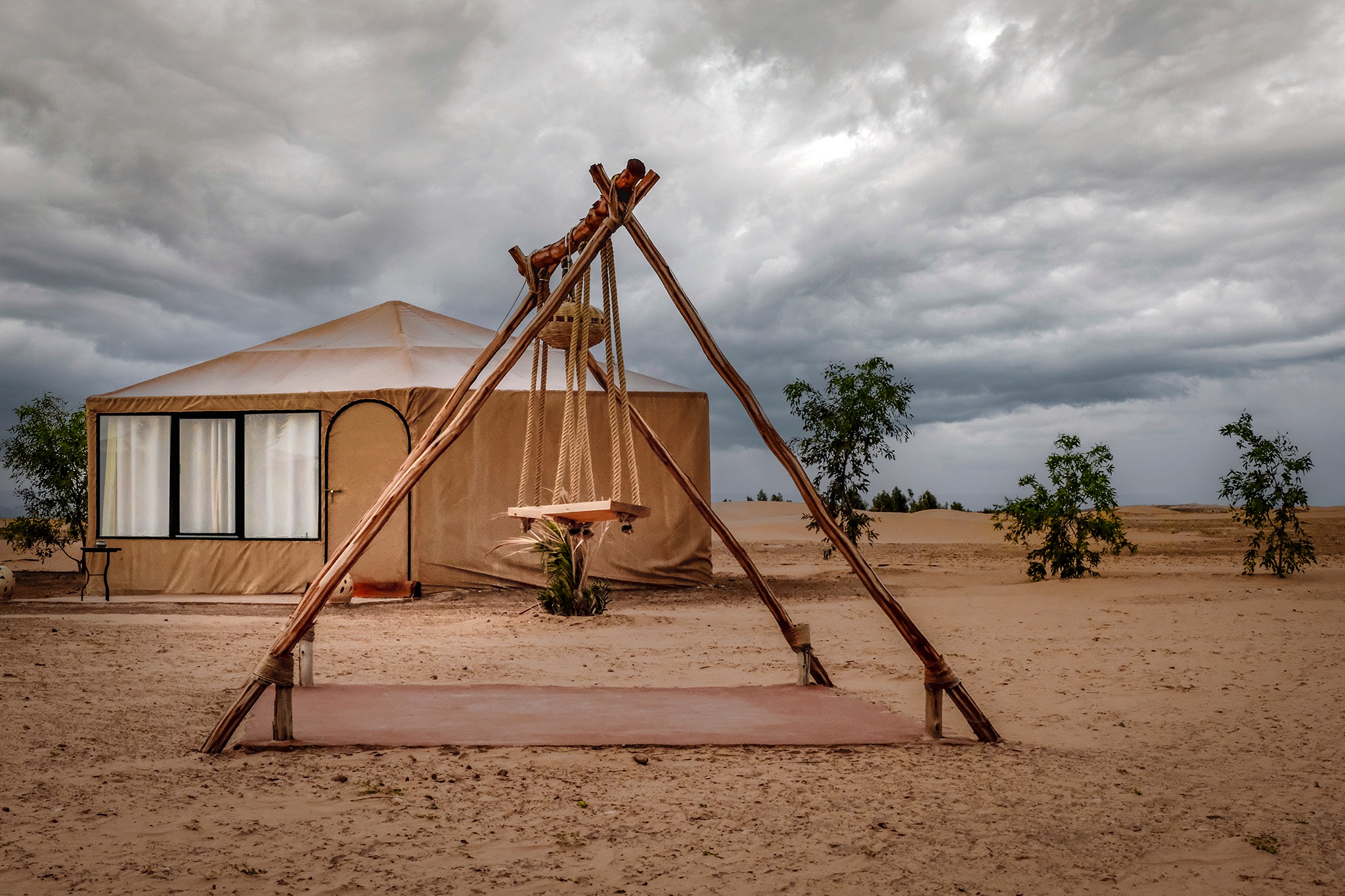
- A private-tent desert camp with its own bathroom and hot water — not a shared washroom block
- An optional sunrise before returning to Merzouga
- A nomad family visit over Berber tea, and Gnawa music in the village of Khamlia
- Camel riding is never mandatory — a 4x4 transfer is available, and quad bikes can be arranged at extra cost
Which Suits You Better?
Private travel isn't automatically better for everyone — it's a trade-off that suits some travelers more than others.
| Private Tour (This Itinerary) | Typical Group Tour | |
|---|---|---|
| Pace | Set around your energy and interests | Fixed to the group's schedule |
| Vehicle | Only your own party | Shared with other travelers |
| Stops | Can be adjusted with your driver | Fixed stops, fixed duration |
| Guiding | Licensed local guides in Fes and Marrakech, driver-guide throughout | Usually one guide for the whole group |
| Customization | Route, accommodation and length can be adjusted before booking | Little to no flexibility once booked |
| Cost | Generally higher per person | Generally lower per person, shared costs |
If your priority is the lowest possible price and you don't mind a fixed schedule, a group departure may suit you better. If flexibility and privacy matter more than sharing costs, this private format is the better fit.
Traveling Morocco Responsibly
Local guides lead the Fes and Marrakech walking tours, and the nomad family visit and Khamlia stop put income directly into the Merzouga community. We ask travelers to be mindful of water use in the desert, avoid leaving waste on the dunes or in the gorges, and ask before photographing people directly — particularly the nomad family and residents of Khamlia. See our Responsible & Sustainable Tourism in Morocco page for more detail.
Who Is This Morocco Tour Best For?
First-Time Visitors
Covers all four imperial cities plus the Sahara without doubling back.
Couples & Photographers
Private pacing allows time for light, views, and unhurried stops.
Cultural & History Travelers
Volubilis, Meknes, and two full guided medina days go deeper than a highlights-only route.
Families
Flexible timing helps, though days 5 and 8 involve long drives worth discussing in advance.
This route may suit you less if you want a slower pace with fewer regions, several beach days, or extensive trekking — in which case a shorter, more focused itinerary or our other Grand Tours may fit better. Driving time varies from around 1 hour on the shortest day to 6–7 hours on the longest legs (Days 5 and 8); the same route can be stretched over more days if you'd prefer shorter drives.
Accommodation
Hotels & Riads
Comfortable hotels in Casablanca, Chefchaouen and the Dades Valley, and riads in the medinas of Fes and Marrakech — chosen for location and quality rather than named as a fixed brand list, since specific properties are confirmed with your booking.
The Desert Camp
One night in a luxury desert camp with a private tent and its own bathroom and hot water — not a shared washroom block. A smaller vehicle (up to 4 people) or minivan (up to 8) is used depending on group size; a minibus for up to 18 can be arranged for larger groups.
What's Included & What's Not
Included
- 10 days of private transport in an air-conditioned 4x4 or minivan, fuel included
- Private English-speaking driver-guide throughout
- Guided walking tour of the Fes medina with a local expert
- Guided walking tour of Marrakech with a local expert
- Nights in quality hotels and riads
- One night in a luxury desert camp with a private bathroom
- Camel trek into the dunes (or a 4x4 transfer as an alternative)
- 4x4 desert excursion around Merzouga
- Sandboards available at the desert camp
- Dinners in the Merzouga camp and in the Dades Valley
- Daily breakfast
- Airport transfers in Casablanca, both directions
Not Included
- Lunches and any dinners not listed above
- Entrance fees to monuments and museums
- Travel insurance
- Tips for your driver-guide and local staff
- Personal expenses
Customize This 10-Day Journey
This route can be shortened, extended, or adjusted around accommodation preference, pace, dietary requirements, and specific interests such as photography stops, a hammam afternoon, or an extra night somewhere you'd like more time.
How Much Does a 10-Day Private Morocco Tour From Casablanca Cost?
There's no single fixed price published for this route, because cost depends on group size, travel dates, accommodation preference, and the vehicle needed for your party. What you receive in your quote is the full breakdown — transport, guiding, accommodation and meals as listed above — so you can compare it clearly against other operators.
Where This Page's Facts Come From
- UNESCO — Archaeological Site of Volubilis — official World Heritage listing.
- UNESCO — Medina of Fez — official World Heritage listing.
- UNESCO — Ksar of Ait-Ben-Haddou — official World Heritage listing.
FAQs — 10-Day Morocco Tour from Casablanca
Is this tour private or shared with a group?
It's a fully private tour — only your own party travels in the vehicle, with your own driver-guide throughout. We don't mix independent travelers into the same car.
How long is the camel trek, and is there an alternative?
The ride into the dunes takes roughly 40 minutes to an hour and a half depending on the camp. If you'd rather not ride, the camp's 4x4 can bring you and your luggage in and out instead, and quad bikes can also be arranged at an extra cost.
Is the desert camp tent private, with its own bathroom?
Yes — the luxury camp used on this itinerary offers private tents with their own bathroom and hot water, not a shared washroom block.
What happens to our luggage during the camel ride?
You only carry what you need for the short ride itself. The rest of your luggage travels separately by 4x4 and will already be at the camp waiting for you on arrival.
What's the best time of year for this itinerary?
Spring (March to May) and autumn (September to November) offer the most comfortable temperatures across both the cities and the desert. Winter works well too, particularly in the south, though nights in the Sahara get cold.
What type of vehicle is used for a group our size?
Smaller groups usually travel in an air-conditioned 4x4 (up to 4 people) or a minivan (up to 8 people). For larger groups, a minibus for up to 18 people can be arranged instead.
How much driving is involved each day?
Driving time varies from around 1 hour on the shortest day to roughly 6–7 hours on the longest legs, broken up with stops for photos, meals and short walks. If you'd prefer shorter driving days, the same route can be stretched over more days instead.
Where does the tour start and end?
Pickup is from Casablanca Mohammed V Airport or your hotel, and the tour drops you back at the airport or your accommodation in Casablanca on day 10.
How much does this 10-day Morocco tour cost?
Pricing depends on group size, travel dates and accommodation preference, so we provide a personalized quotation rather than a fixed listed price.
How is this different from Desert Morocco Tour's other 10-day itinerary?
This route includes Rabat, Volubilis and Meknes on the way north, and spends two full nights in the Sahara rather than one, with no stop in Essaouira. Our other 10-day itinerary follows a different balance of stops — ask your travel specialist which fits your interests better if you're comparing the two.
Start Planning Your Private Morocco Tour.
This itinerary can also be shortened or extended — send your dates and questions and we'll help you find the right length for your trip.